
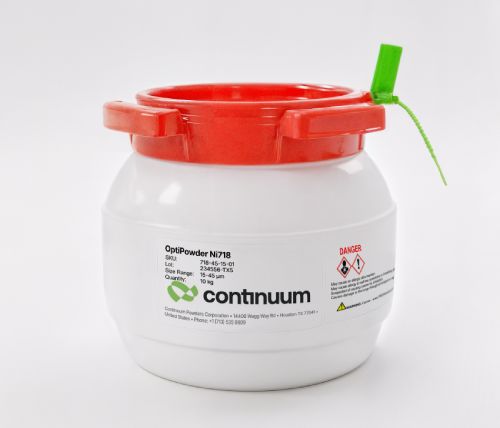
OptiPowder Ni718
PSDs Available:
- Description
- Typical Applications
- Physical Properties
- Nominal Composition
- Printed Properties
- AM Process Compatibility
- Available PSDs & Customization
- Documents
OptiPowder Ni718
Continuum OptiPowders are produced by our proprietary M2P Gas Atomization System. This advanced plasma-based process transforms reclaimed metal revert streams into high-quality spherical powder in a single step. By utilizing 100% reclaimed feedstock and green energy sources, this process significantly reduces the carbon footprint while delivering exceptional material performance and flowability.
Material Overview
Ni718 is a nickel-chromium-molybdenum-niobium precipitation-hardened superalloy known for excellent machinability in the solution-annealed state and outstanding strength after heat treatment. It offers sustained high-temperature strength, stress rupture resistance, cryogenic stability, and oxidation resistance, making it a workhorse alloy for demanding environments.
OptiPowder Ni718 is engineered for advanced manufacturing applications requiring high-temperature resistance up to approximately 1,200°C (2,200°F). It is widely used in aerospace, power generation, automotive, oil & gas, and emerging energy systems for components such as turbine blades, hot-section hardware, rocket motors, combustion chambers, and other stress-critical parts.
OptiPowder Ni718 is engineered for high-temperature, high-reliability components, including:

Aerospace turbine blades, vanes, rocket motors, and combustion hardware.

Power-generation and industrial gas-turbine hot-section components.

Oil and gas parts exposed to aggressive, corrosive media.

Energy and fuel-cell structures where stability from cryogenic to elevated temperatures is required.
Powder Physical Properties
| Property | Unit | Min | Max |
| Flow (Hall) | s/50g | 10 | 20 |
| Apparent Density (Hall) | g/cc | 4 | - |
| D101 | μm | 15 | 25 |
| D501 | μm | 25 | 35 |
| D901 | μm | 35 | 50 |
| +63 μm2 | wt. % | - | 0 |
| +53 μm2 | wt. % | - | 1 |
| +45 μm2 | wt. % | - | 5 |
1. Per ASTM B822 2. Per ASTM B214 - Data representative of 15–45 μm PSD.
Nominal Composition (wt.%)
| Element | Min | Max | Element | Min | Max |
| Ni | 50.0 | 55.0 | Si | - | 0.35 |
| Cr | 17.0 | 21.0 | Ti | 0.65 | 1.15 |
| Mo | 2.80 | 3.30 | Al | 0.20 | 0.80 |
| Fe | Balance | Balance | C | - | 0.08 |
| Nb+Ta | 4.75 | 5.50 | P | - | 0.015 |
| Co | - | 1.00 | S | - | 0.015 |
| Mn | - | 0.50 | B | - | 0.006 |
Conforms to AMS 7006
Printed Properties (Room Temperature)
| Printed On | Concept Laser | EOS 290 | ASTM F3055 | |
| Direction | OptiPowder Ni718 | OptiPowder Ni718 | ||
| Tensile Strength | XY | 1411 | 1423 | 1240 |
| (MPa) | Z | 1386 | 1356 | 1240 |
| Yield Strength | XY | 1225 | 1218 | 940 |
| (MPa) | Z | 1179 | 1170 | 920 |
| Elongation (%) | XY | 24 | 37 | 12 |
| (MPa) | Z | 23 | 26 | 12 |
Conforms to ASTM F3055-14 - Data representative of 15–45 μm PSD.
Additive Manufacturing Process Compatibility
OptiPowder Ni718 supports a wide range of advanced-manufacturing processes, including:
Laser Powder Bed Fusion (LPBF):
complex, high-precision geometries with excellent mechanical properties
Binder Jetting (MBJ):
cost-effective production of larger parts at lower density prior to consolidation
Hot Isostatic Pressing (HIP):
full-density consolidation, defect reduction, & property enhancement for additively manufactured or near-net-shape parts
Electron Beam Melting (EBM):
large, heavily loaded structures requiring high strength
DED and other Advanced Routes
where controlled PSD and chemistry are critical
Available PSDs & Customization
OptiPowder Ni718 is available in multiple particle size distributions tailored to specific platforms and processes (for example, 15–45 µm and 15–53 µm for LPBF/EBM, and coarser cuts for binder jetting or HIP). Custom PSDs, blends, and program-based supply arrangements are available on request to support unique process windows or qualification requirements.
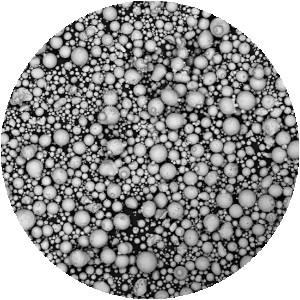
Figure 1
Morphology
Powder morphology is predominantly spherical with minimal satellites, with no hollow particles, excessive agglomeration, or foreign-object defects visible at ~300× magnification, as illustrated in Figure 1.
Blending
Multiple heats may be blended into a single lot when each heat independently meets all chemical and PSD requirements.
Certification
Each shipment includes a certificate of analysis reporting chemical composition, particle size distribution, and any additional agreed-upon test results demonstrating conformance to specifications.