When evaluating metal powders for additive manufacturing, particle size distribution often gets the most attention. But size alone doesn’t determine how a powder will behave during printing. Equally important — and sometimes more influential — is powder morphology.
Morphology describes the shape, surface condition, and structural features of individual powder particles. These characteristics play a critical role in how powders flow, spread, pack, and interact with energy sources during printing. Two powders with similar PSDs can perform very differently if their morphology differs.
This article explains what powder morphology is, the key features engineers should understand, and why shape and surface condition matter across additive manufacturing processes.
What Is Powder Morphology?
Powder morphology refers to the physical characteristics of individual particles, including their overall shape, surface texture, and the presence of features such as satellites or internal porosity.
In additive manufacturing powders are often described as spherical, but in practice, most powders exist along a spectrum. Some particles may be nearly perfectly spherical, while others exhibit elongation, surface roughness, or attached particles.
These morphological details influence how particles interact with one another — and with the process — in ways that PSD alone cannot capture.
Particle Shape: More Than Just “Spherical”
Spherical particles are generally preferred in additive manufacturing because they promote consistent flow and predictable packing behavior. When particles are round and smooth, they tend to roll easily, reducing friction during spreading or feeding.
Irregularly shaped particles, by contrast, can interlock or resist movement, leading to inconsistent flow, poor layer uniformity, or feeding interruptions. In powder bed–based systems, this can translate into uneven layers. In directed energy deposition, it can result in unstable powder delivery.
That said, perfectly spherical particles are not always necessary. What matters most is consistency — powders with uniform shape tend to behave more predictably than those with a wide mix of morphologies.
Surface Texture and Roughness
Beyond overall shape, surface texture plays a meaningful role in powder behavior. Smooth particle surfaces generally support better flowability, while rough or irregular surfaces increase friction between particles.
Surface roughness can be influenced by atomization method, cooling rates, and post-processing steps. Rougher surfaces may increase apparent cohesion within the powder bed, which can negatively affect spreading and layer uniformity.
At the same time, surface texture can influence how particles absorb energy during processes such as laser melting. These effects are highly application-dependent, reinforcing the need to evaluate morphology in the context of the specific AM process.
Satellites and Agglomerates
Satellites are small particles that adhere to the surface of larger particles during powder production. While often unavoidable, excessive satellite formation can significantly impact powder performance.
Satellites increase surface roughness and effective particle size, which can reduce flowability and alter packing behavior. In some cases, they can also affect how powders interact with binders or energy sources.
Agglomerates — clusters of multiple particles bonded together — present similar challenges. Even when PSD data appears acceptable, agglomeration can lead to inconsistent spreading or feeding if not properly controlled. Agglomerates have an increased surface area to volume ratio which changes a variety of properties such as flowability, sintering, melting, and packing.
How Morphology Interacts with PSD
Morphology and particle size distribution should never be evaluated independently. The same PSD can behave very differently depending on particle shape and surface condition.
For example, a narrow PSD composed of highly spherical particles may flow better than a broader PSD with irregular morphology. Conversely, a slightly broader distribution with smooth, spherical particles may outperform a tighter distribution with rough surfaces or high satellite content.
This interaction is why relying on PSD percentiles alone can lead to incomplete or misleading conclusions about powder performance.
Morphology Considerations by Process
Different additive manufacturing processes place different demands on powder morphology.
In laser powder bed fusion, smooth, spherical particles support uniform layer spreading and stable melt pool formation. Satellites and rough surfaces can disrupt layer quality and contribute to defects.
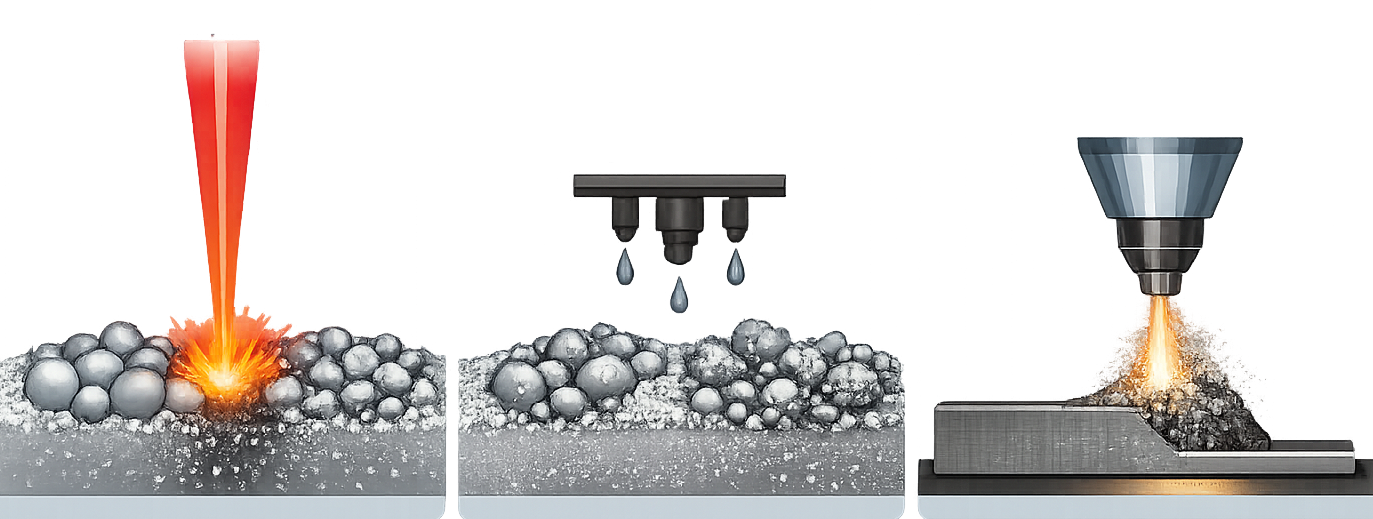
From left to right, examples of Laser Powder Bed Fusion, Binder jetting, and Directed Energy Deposition
In binder jetting, morphology influences how powders spread and pack, as well as how binders wet and penetrate the powder bed. Surface texture and satellite content can affect green strength and sintering outcomes.
In directed energy deposition, consistent particle shape supports stable powder flow through delivery nozzles, reducing variability during deposition.
Understanding these process-specific sensitivities helps engineers prioritize which morphological features matter most.
Evaluating Morphology in Practice
Powder morphology is commonly evaluated using scanning electron microscopy (SEM), which provides visual insight into particle shape, surface condition, and satellite presence. While SEM images are often qualitative, they can reveal issues that numerical data alone cannot.
When reviewing morphology data, consistency across particles and lots is often more important than achieving an idealized shape. Predictable behavior depends on repeatability as much as absolute performance.
Morphology as Part of a Broader Powder Strategy
Like particle size distribution, morphology is best understood as part of a broader powder strategy rather than a standalone acceptance criterion. Shape, surface condition, PSD, flowability, and chemistry all work together to influence how powders perform in real-world manufacturing environments.
Evaluating morphology alongside these other parameters helps teams select powders that behave consistently during printing and post-processing — reducing variability as programs scale toward production.