When engineers evaluate metal powders, most of the focus tends to land on particle size distribution, morphology, and flow behavior. Those are the characteristics that show up clearly on datasheets and in process discussions.
But there’s another layer of the material that doesn’t always get the same attention — even though it can have a meaningful impact on performance.
Surface chemistry.
It’s not as visible as particle size or shape, but it plays a role in how powders behave during printing and how parts perform once they’re built.
What Surface Chemistry Actually Refers To
Even when a powder’s bulk composition is tightly controlled, the outer surface of each particle can tell a different story.
Exposure to oxygen, moisture, and processing environments leads to the formation of thin surface layers — often oxides, absorbed moisture, or trace contamination — that sit on top of the base material. These layers are typically very small in thickness, but they still influence how particles interact with each other and with the manufacturing process.
That’s what we’re referring to when we talk about surface chemistry.
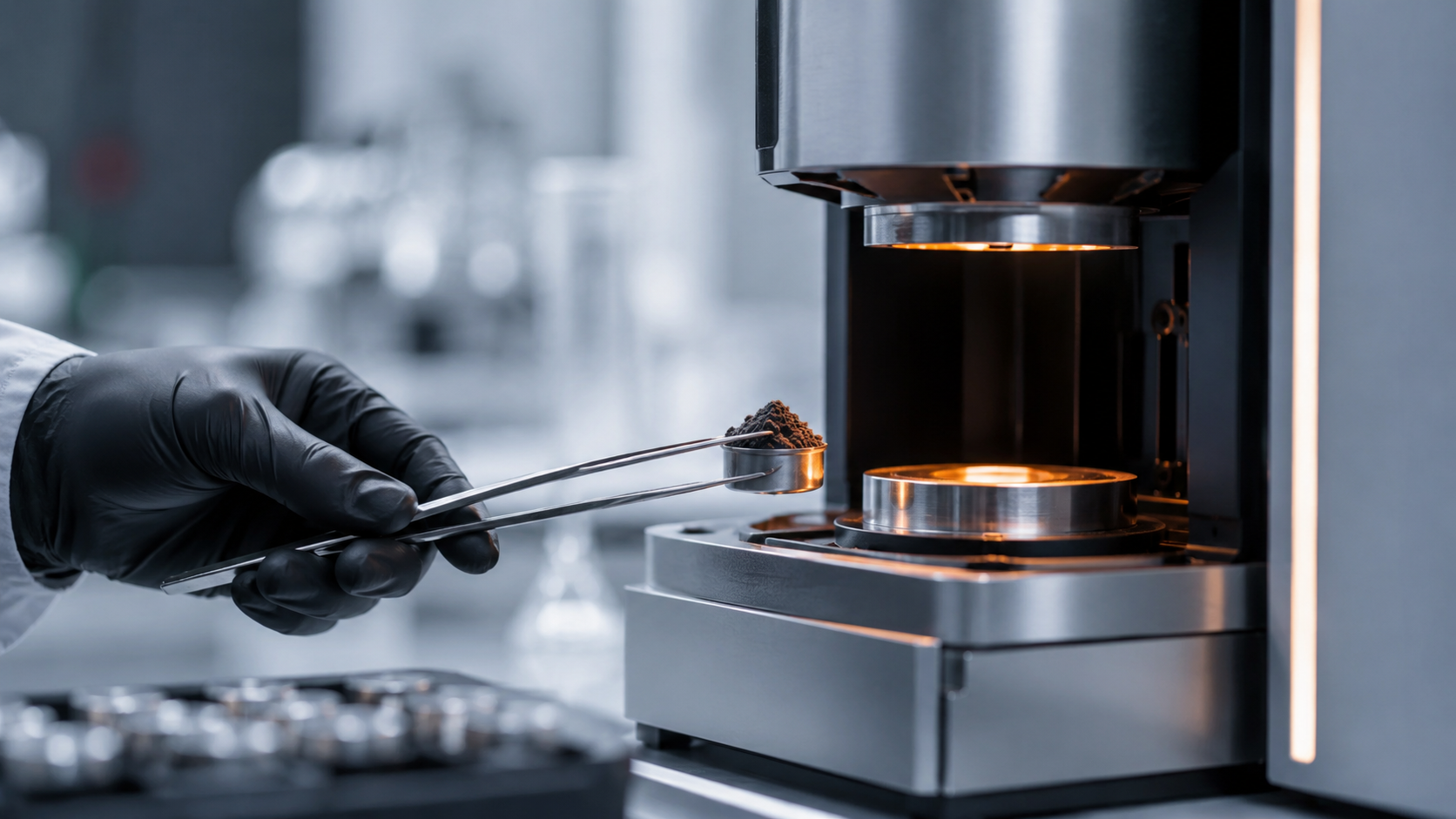
Metal powder sample preparation for surface chemistry and oxidation analysis, helping evaluate how surface condition, oxygen exposure, and contamination can influence powder performance in AM.
Oxidation Is Almost Always Present
Most metal powders develop some level of oxidation, both during atomization and through subsequent exposure to air. The extent depends on the alloy, how the powder was produced, and how it’s handled and stored.
In many cases, the oxide layer is stable and doesn’t create immediate issues. But that doesn’t mean it’s irrelevant.
Changes in oxidation levels — even subtle ones — can influence how powders behave during spreading, how they interact with binders, or how they respond to thermal input during processing.
Where Surface Chemistry Starts to Matter
Surface chemistry tends to show up in ways that aren’t always obvious at first.
It can influence how particles stick to one another, which affects flow behavior. It can change how binders wet and adhere in binder jetting. In laser-based processes, it can affect how energy is absorbed at the particle surface. The direction of that effect isn’t always intuitive — for some alloys, a thicker oxide layer can actually improve laser absorption, while for others it interferes with melting.
None of these effects happen in isolation, and they don’t always show up in standard powder metrics. But over time, they can contribute to variability if they aren’t understood and controlled.
Passivation: Turning Oxidation Into a Controlled Variable
For some materials, oxidation isn’t just tolerated — it’s deliberately induced. Passivation is the controlled formation of a thin, stable surface layer that protects the underlying metal from further reaction.
For reactive alloys like aluminum, magnesium, and titanium, passivation is a standard step after atomization. Freshly atomized particles of these metals are pyrophoric — fine enough and reactive enough to ignite in air — so manufacturers expose them to a controlled, oxygen-limited environment before the powder is removed from the collector. The result is a thin, uniform oxide that stabilizes the powder for safe handling, storage, and processing.
Even for less reactive alloys like stainless steels and nickel superalloys, the native oxide that forms after atomization functions as a kind of natural passivation layer. It isn’t engineered in the same deliberate way, but it serves a similar role: once it forms, it slows further oxidation and gives the powder a more stable surface chemistry over time.
The practical takeaway is that not all oxidation is unwanted. A well-controlled, uniform passivation layer can actually contribute to consistency — what causes problems is uncontrolled or uneven oxidation that develops later through poor handling, exposure to humidity, or repeated reuse.
Impact on Final Part Performance
Surface chemistry doesn’t just affect powder handling — it can carry through to the final part.
Higher levels of oxidation or contamination can influence mechanical properties, including strength and fatigue performance. They can also affect microstructure and defect formation, particularly in applications where consistency is critical.
For industries like aerospace, defense, and energy, where performance margins are tight, those differences matter.
Managing Surface Chemistry in Practice
Surface condition is influenced by several factors, including how the powder is produced, how it’s handled, and how it’s stored.
Controlling exposure to oxygen and moisture, maintaining consistent processing conditions, and monitoring key indicators like bulk oxygen content, with surface-specific techniques such as XPS used when finer detail is needed, all play a role in keeping surface chemistry within acceptable bounds.
It’s not about eliminating oxidation entirely — that’s rarely realistic — but about managing it so it remains stable and predictable.
Why It’s Often Overlooked
Part of the reason surface chemistry doesn’t always get the same attention is that it’s harder to see.
You can measure PSD directly. You can visualize morphology with SEM. Surface chemistry requires a different set of tools and, in many cases, a deeper level of analysis.
Because of that, it’s sometimes treated as a secondary consideration — at least early on.
But as processes scale and tolerances tighten, it becomes harder to ignore.
Surface Chemistry as Part of a Powder Strategy
Surface chemistry is often less visible than other powder characteristics, but it plays a critical role in determining how powders behave during processing and how parts ultimately perform.
Interpreting surface condition alongside particle size distribution, morphology, and flow behavior requires a holistic view of the material system. In practice, many advanced manufacturing teams work closely with powder suppliers to monitor and control these variables over time, helping ensure consistent performance as applications move from early development into production environments.