Not every alloy program requires tens of thousands of kilograms of powder before meaningful technical work can begin.
In many important materials programs, the first useful quantity is much smaller. A research team may need enough powder to compare three or four variations of a new composition. A defense program may need a controlled run to evaluate whether a modified alloy can meet a specific performance requirement. A manufacturer working with high-value feedstock may need a practical route to recover, reuse, or requalify material without committing to a full production campaign.
These are not fringe applications. They represent a growing part of advanced manufacturing as the industry moves toward more specialized applications in aerospace, defense, energy, medical, and other high-value industrial markets.
For many years, much of the discussion in metal additive manufacturing has focused on the machine side of the equation: build rates, larger platforms, part design, and qualification. Those are important topics. However, they are not sufficient by themselves. Behind every successful metal AM application is a materials system that must be designed, produced, characterized, tested, and repeated with discipline. This is where small-batch alloy development is becoming strategically important again.

Metal powder sample preparation for surface chemistry and oxidation analysis
Traditional powder production infrastructure was built primarily around volume. That is appropriate for established alloys and mature production programs, where throughput, lot-to-lot consistency, and cost per kilogram are the dominant concerns. Alloy development rarely begins under those conditions. Early-stage materials work is uncertain by nature. A team may not yet know which chemistry will perform best. It may need to compare narrow compositional changes. It may need to determine whether recycled feedstock can be converted back into usable powder. It may only require 10, 20, or 50 kilograms to generate meaningful data.
Under those conditions, large-scale production infrastructure can become a barrier rather than an advantage.
The issue is not simply that large atomizers are too big. The issue is that they are optimized for a different economic model. Interrupting a production system, cleaning it thoroughly, running a small development quantity, and preparing it for the next alloy can be inefficient and expensive. The challenge becomes even greater when cross-contamination risk is high, when the alloy contains reactive elements, or when the alloy requires tight compositional control. For development work, the ability to move quickly, efficiently, and process relatively small quantities matter most.
This is why small-batch alloy development is becoming more relevant. The industry is entering a phase where materials agility is no longer optional but rather an important capability.
Integrated Computational Materials Engineering (ICME) alloy modeling, AI assisted alloy design, and data tools accelerate materials development, but they do not remove the need for physical validation. At some point, a proposed alloy must be melted, atomized or otherwise converted to powder, characterized, processed, and tested. In many casesimilarrk involves several variants of a similar chemistry. The differences may appear small on paper, but they can be meaningful in performance. A modest chemistry adjustment can influence powder morphology, flowability, printability, microstructure, heat treatment response, and final mechanical properties.

That type of work requires a flexible development environment. It also requires infrastructure that reflects the practical realities of metallurgical experimentation. Yields may vary. The first run may not be the final run. Cleaning and changeover matter. Feedstock form matters. Powder size distribution matters. Oxygen, hydrogen, and other interstitials may matter. So does the ability to continue learning without forcing a project into production-scale economics before the material is ready.
This is particularly important for proprietary alloys.
Many organizations are increasingly developing alloys for specific applications, processes, and performance environments. These materials may not exist in standard scrap streams. They may be protected by intellectual property. In some cases, a company may not want oversized powder, support structures, failed builds, scrap, or end-of-life components entering the open market because the material itself represents years of development work.
That creates a practical question: what should happen to that material?
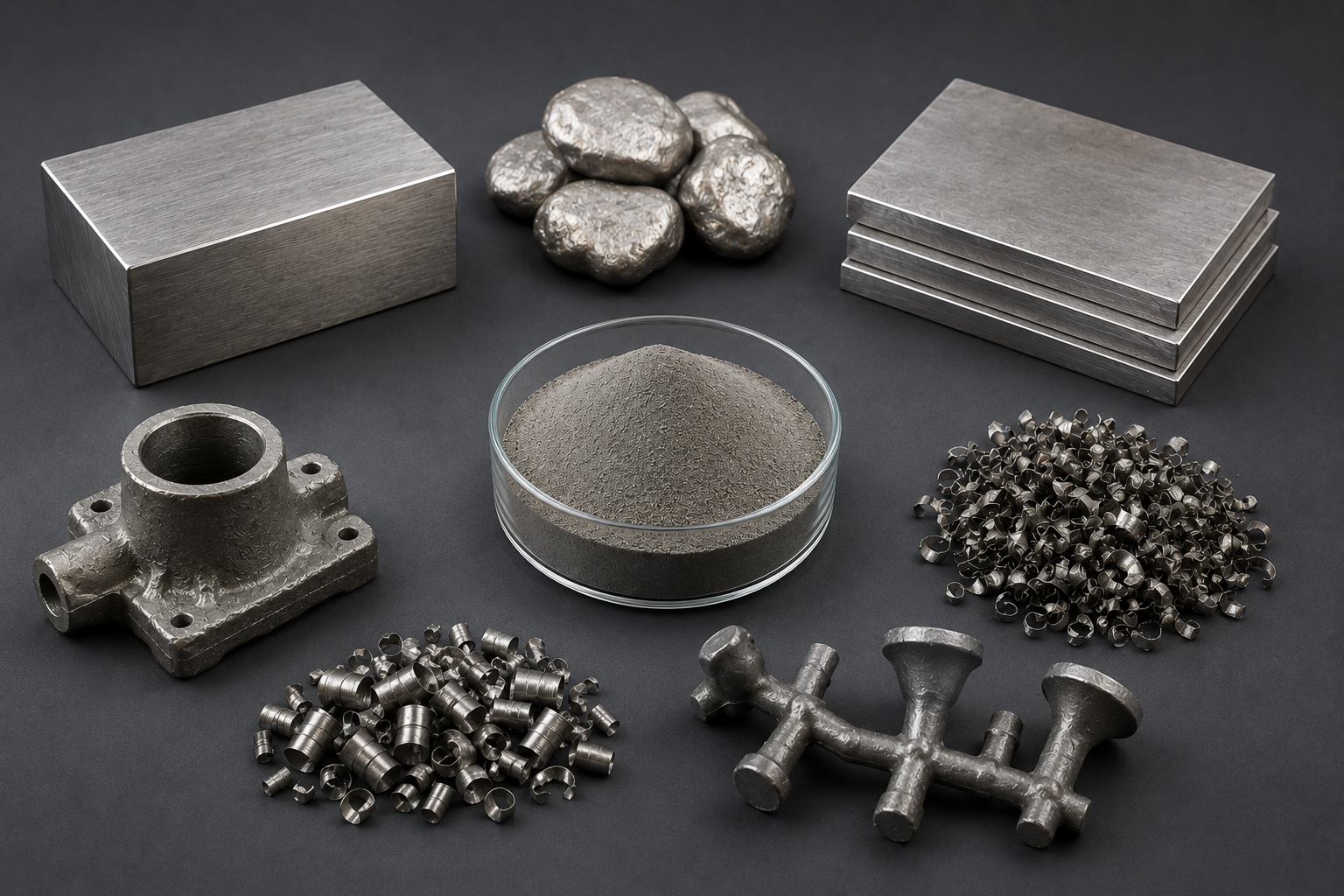
Different types of Metal Feedstock
For conventional alloys, recycling pathways may be relatively straightforward. For proprietary or highly specialized alloys, the situation is more complex. The material may have significant value, but it may also require controlled handling. The organization may want it converted back into usable powder or other prime feedstock without being mixed into a broader scrap stream or sold externally. In these cases, small-batch remelting, atomization, and powder conversion can provide a practical route for reuse while preserving control of the material.
The economics become even more compelling when high-value feedstocks are involved.
For precious metals, refractory alloys, titanium alloys, nickel superalloys, and other expensive alloy systems, the value of the base material can exceed the cost of the processing step. In those cases, recovering usable material is not simply a sustainability benefit. It can be a major economic driver. A small, controlled run may make far more sense than purchasing new material or accepting the loss of valuable scrap. It also allows organizations to explore new compositions, powder forms, or requalification pathways without committing prematurely to a large-volume model.
The same logic applies to defense, aerospace, and government-funded materials development. These programs often require controlled quantities of powder for testing, qualification, alloy modification, or risk reduction. They may not need a full production campaign at the beginning. What they need is enough material to generate data, build representative parts, and determine whether the alloy is worth advancing.
This is where the gap between laboratory-scale and production-scale infrastructure becomes clear.
Laboratory atomizers and research systems are important for academic and early-stage materials science. They can support very small quantities and early screening. However, many industrial programs need more than a few grams or a few samples. They need enough powder to run meaningful AM trials, evaluate repeatability, produce test articles, and understand how the material behaves in the intended process. At the same time, they may not be ready for thousands of kilograms.
Small-batch alloy development occupies this middle ground.
It gives materials teams a practical bridge between concept and production. It supports iteration without overcommitment. It allows teams to test multiple alloy variants, evaluate powder behavior, understand processing response, and make better decisions before scaling. It also provides a more controlled pathway for organizations working with secure, proprietary, or high-value materials.
This does not mean every alloy program should remain small. In many cases, the purpose of development is to reach production. But the path to production is rarely linear. A flexible development capability allows teams to learn faster, reduce risk earlier, and scale around known requirements rather than assumptions. Once the material is validated, production can be designed around the chemistry, process window, and performance requirements that have already been demonstrated.
For the additive manufacturing industry, this shift matters.
As the market matures, the next wave of progress will not come only from faster printers or larger build chambers. It will also come from better materials, more specialized alloys, and more disciplined pathways from development to qualification. That requires infrastructure designed not only for volume, but also for learning, iteration, and control.
Small-batch alloy development gives the industry a way to do this work more intelligently.
It recognizes that advanced manufacturing is becoming more application specific. It acknowledges that materials are not interchangeable commodities. It gives engineers, metallurgists, and manufacturers a more practical way to move from alloy concept to usable powder without forcing every project into a production-scale model before the science is ready.
For an industry built on precision, performance, and repeatability, that kind of flexibility is not a luxury.
It is becoming a strategic necessity.
This article was originally published via Voxel Matters on June 19, 2026