
Finding a material that meets an application's requirements is one challenge. Obtaining that material in the right powder form, quantity, and condition for manufacturing can be another.
For manufacturers working with additive manufacturing and other powder-based processes, that distinction matters. A material may offer the strength, corrosion resistance, or thermal performance an application requires, yet still present challenges when it comes to powder availability, particle size distribution, processing behavior, or development quantities.
And sometimes, an established alloy simply doesn't meet the requirements in the first place.
In either situation, the next step isn't necessarily to commit to a new material at production scale. It may be to start smaller, define what needs to be learned, and build the evidence needed to make an informed decision.
Download Brochure
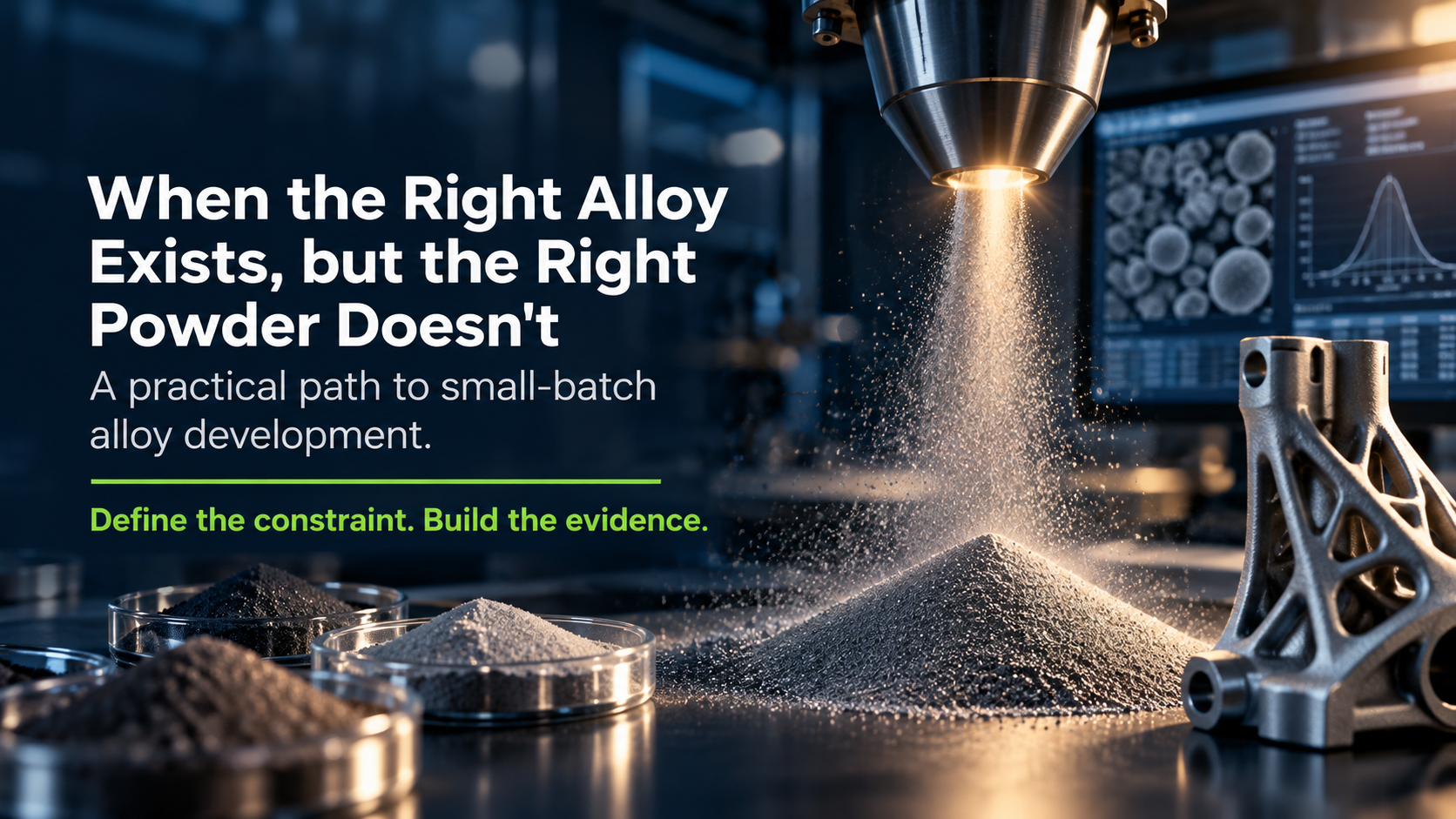
First, Identify What's Actually Holding the Application Back
Not every material challenge requires an entirely new alloy chemistry.
In some cases, the chemistry is already suitable, but the powder isn't available in the quantity or particle size range required for testing. In others, a material developed for one manufacturing process may not behave as expected in another.
There are also economic considerations. When working with scarce or high-value feedstocks, material utilization and the handling of unused material can influence whether a development program is practical.
And for proprietary alloys, questions surrounding material custody, intellectual property, and data ownership may be just as important as the technical requirements. Before moving forward, manufacturers need to establish which constraint they're trying to solve.
Is the problem material performance? Powder availability? Manufacturing compatibility? Development economics? The answer should shape the next trial.
Why Small-Batch Development Matters
Custom alloy development involves uncertainty. That's part of the process.
A promising chemistry may not produce powder with the characteristics needed for a particular manufacturing route. An initial trial may reveal that additional process development is required, or that the material isn't suitable for the intended application.
Small-batch development creates an opportunity to investigate those questions before committing to larger production volumes.
The objective is to produce representative powder, collect meaningful data, and evaluate whether the material warrants further investment. That requires more than simply running material through an atomization system.
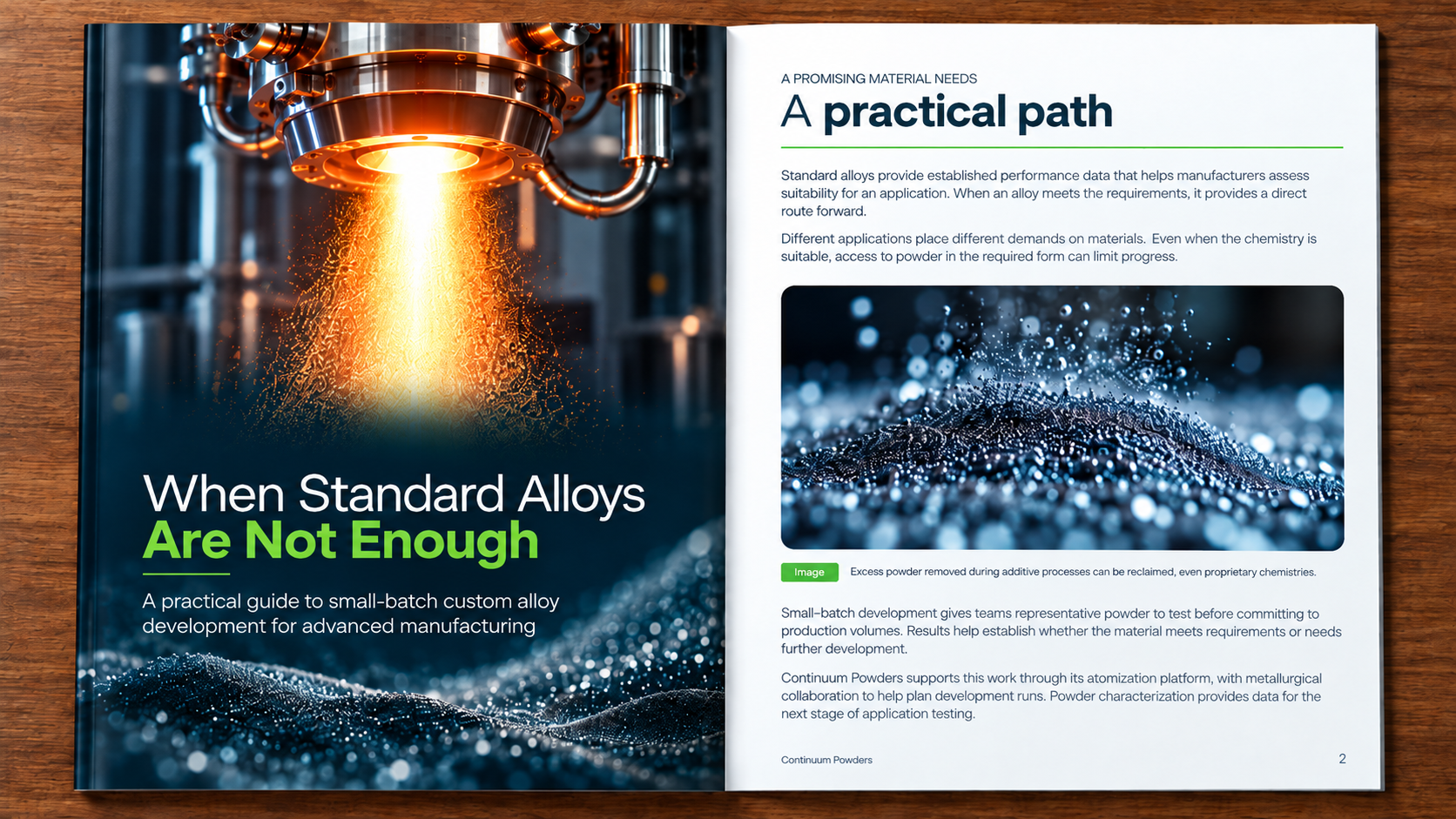
Download our guide, When Standard Alloys Are Not Enough, to explore the development pathway, important powder data considerations, and ten questions to ask before your first custom alloy run.
A useful development program begins with clearly defined requirements, agreed success criteria, and a plan for how the resulting powder will be evaluated.
Build the Trial Around the Question You Need to Answer
Consider two different development objectives. One manufacturer may want to compare several alloy chemistries to determine which offers the most promising performance for a demanding application.
Another may already have an established chemistry but need powder in a particular particle size distribution for process development.
Those programs require different approaches.
For the first, the priority may be comparing material variants and their resulting characteristics. For the second, the focus may be on producing suitable powder for manufacturing trials and understanding the associated yield and processing behavior.
In both cases, the development run should be designed around the evidence the manufacturer needs.
That includes agreeing on feedstock requirements, target chemistry, particle size distribution, characterization methods, and the criteria that will determine what happens next.
Powder Characterization Is the Beginning, Not the Finish Line
Producing powder that meets an agreed specification is an important milestone, but it doesn't establish how a finished component will perform. That requires application-specific testing.
Depending on the program, powder characterization may include chemical composition, particle size distribution, morphology, flow properties, density measurements, and relevant contamination or traceability records.
Those results establish the powder's starting condition and help inform subsequent manufacturing trials.
From there, manufacturers can evaluate how the material behaves in their process, whether it meets application requirements, and what additional development or qualification work may be necessary.
It's a progression built on evidence rather than assumptions.
Plan for Production While You're Still Developing
A successful initial trial doesn't automatically mean a material is ready for production.
Manufacturers also need to consider whether the required feedstock can be sourced consistently, whether powder characteristics can be repeated across production lots, and whether the economics remain viable at larger quantities.
Questions about yield, material handling, traceability, and process changes become increasingly important as development progresses.
Addressing those considerations early can help teams determine whether a promising material has a practical path forward.
A More Practical Approach to Custom Alloy Development
At Continuum Powders, our Custom Foundry Runtime (CFR) offering provides structured access to our Greyhound atomization platform for alloy development, process validation, and controlled production.
Programs are scoped around agreed technical requirements, with metallurgical collaboration and powder characterization supporting the next stage of application testing. Because output and yield depend on the alloy and process conditions, each program is evaluated individually.
The goal is to help manufacturers investigate material opportunities with a clearer understanding of the requirements, risks, and evidence needed to move forward.
For teams evaluating a specialty alloy, the most important first step may be defining the problem the next development run needs to solve.
Have a material challenge you'd like to discuss? Connect with Continuum Powders.