By Matt Charles - Chief Technology Officer, Continuum Powders
As additive manufacturing matures beyond early hype, the conversation is shifting from possibility to practicality—and materials are at the center of that transition.
For a long time, additive manufacturing was sold as a kind of magic. Push a button. Print anything. Replace traditional manufacturing.
That’s not how it played out. And that’s not a bad thing. Because in many areas today, additive is no longer an edge case. In some industries, it’s already the go-to approach.
What’s changing now isn’t whether additive works. It’s how well we understand where it works best.
People are asking better questions. Not “can we print this?” but “should we?”
That shift is starting to shape how engineers think about materials, performance, and supply chains.
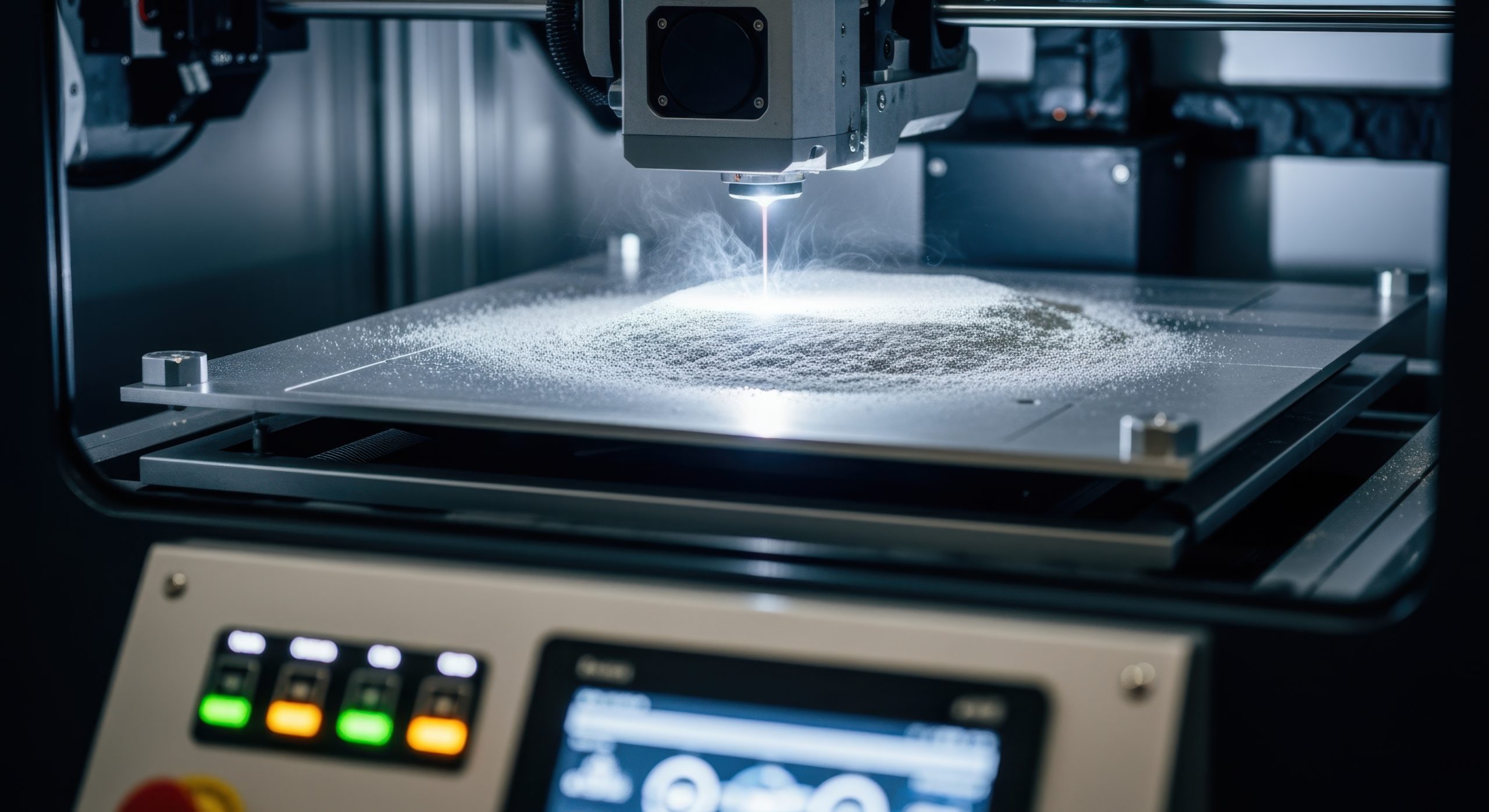
Detailed shot of metal powder bed in a large 3D printer highlighting cuttingedge technology for aerospacegrade part fabrication.
From Possibility to Practicality
In the early days of additive, there was a tendency to compare printed parts directly to wrought or cast equivalents. The expectation was often that additive could serve as a one-to-one replacement.
That assumption didn’t hold up.
Additive manufacturing offers a different set of trade-offs. In some cases, it delivers clear advantages like design freedom, part consolidation, or reduced lead times. In others, particularly where fatigue performance or extreme reliability is required, traditional manufacturing methods still have the edge.
The industry is beginning to accept this reality.
Rather than forcing additive into every application, manufacturers are identifying where performance, cost, and feasibility converge. This has led to a more disciplined approach to adoption, particularly in sectors like aerospace and defense, where performance margins are tightly controlled.
The Role of Risk—and How It Evolves
One of the biggest barriers to broader adoption isn’t technical capability but risk perception.
When additive is used for non-critical components, the tolerance for variability is higher. But as applications move into regulated or safety-critical environments, the expectations change. Material consistency, repeatability, and long-term performance all come under scrutiny.
This is where the industry has made meaningful progress.
Part of the challenge early on was how engineers are trained to think about materials. If you’re working on a high-performance or fatigue-limited component, you’re used to pulling data from a trusted source. Something like MMPDS, where material properties, loads, and failure probabilities are well understood.
Additive didn’t fit that model.
Instead of starting with a known material baseline, you were jumping straight to a printed part with less historical data behind it. For a lot of engineers, that felt like trying to fit a round peg into a square hole.
Over time, that’s started to change. Process control has improved. Testing has improved. Qualification methods are more defined. Engineers now have a better sense of how printed parts behave, where they perform well, and just as importantly, where they don’t.
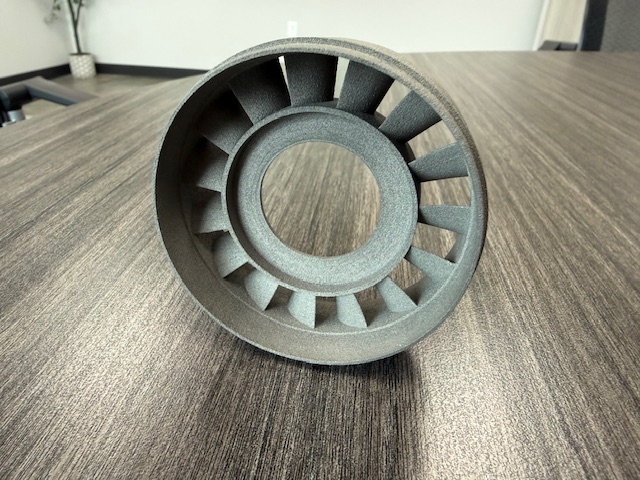
Binder jet component printed with OptiPowder M247
There’s also another side to this. Additive isn’t always about matching what came before. In some cases, it opens the door to using different materials altogether.
We saw this in a landing gear program, where a cast aluminum component could be replaced with a printed titanium one. Not because it was easier, but because additive makes it more practical to work with high-performance, hard-to-machine alloys. In that case, the idea was to use a higher performance material as a safety factor. Knowing the titanium would be overkill for the application, it helped offset any uncertainty in the printed part, making long-term performance less of a concern.
In situations like that, the conversation shifts. It’s no longer about whether additive can replicate a part. It’s about whether it can build a better one.
There’s also another side to this. Additive isn’t always about matching what came before. In some cases, it opens the door to using different materials altogether.
We saw this in a landing gear program, where a cast aluminum component could be replaced with a printed titanium one. Not because it was easier, but because additive makes it more practical to work with high-performance, hard-to-machine alloys. In that case, the idea was to use a higher performance material as a safety factor. Knowing the titanium would be overkill for the application, it helped offset any uncertainty in the printed part, making long-term performance less of a concern.
In situations like that, the conversation shifts. It’s no longer about whether additive can replicate a part. It’s about whether it can build a better one.
Why Materials Are Becoming the Bottleneck
As additive systems and processes improve, materials are increasingly becoming the limiting factor.
Not just in terms of availability, but in how well they are engineered for the process. And how well they match the specific printing technology being used. In some cases, even the machine itself.
For years, much of the industry focused on meeting baseline specifications, such as chemical composition, particle size distribution, and other standard metrics. Those are still important, but they don’t tell the whole story.
Powder characteristics such as morphology, surface condition, and internal porosity play a significant role in how a material behaves during a build. These factors influence flowability, packing density, and ultimately the consistency of the final part.
As additive moves toward production environments, these details matter more than ever. But even when everything looks right on paper, there’s still no guarantee of a good part.
Rethinking Feedstock: Cost, Supply, and Opportunity
Many high-value metals—particularly titanium and nickel-based alloys—generate significant amounts of scrap during conventional processing. In some industries, the majority of the starting material never makes it into the final part. Buy-to-fly ratios can be as high as 20 to 1.
Historically, much of that excess material has been underutilized or difficult to repurpose. Not just because of quality concerns, but because of form. A lot of it doesn’t fit neatly into traditional recycling streams or standard atomization processes that rely on wire or bar feedstock.
That is starting to change.
There is increasing interest in converting existing material streams into usable feedstock for additive processes. While this approach is often framed through the lens of sustainability, the economic case is just as compelling.
In many cases, alternative feedstock sources can offer meaningful cost advantages, particularly in markets where material cost is a primary constraint.
The Perception Gap
Despite these advantages, adoption is not purely a technical question.
There is still a perception gap when it comes to non-traditional feedstocks. For some applications, particularly those involving critical components, the idea of using reclaimed or secondary material introduces an additional layer of concern.
This is not unusual.
Every new material pathway goes through a similar cycle: initial skepticism, followed by gradual validation, and eventually broader acceptance. The same pattern has played out across global supply chains, where materials once considered risky are now widely used.
The key is data, consistency, and time.
We’ve seen this kind of shift before. Ten years ago, many manufacturers wouldn’t touch certain overseas powder sources. There were concerns about quality, consistency, and traceability. Today, some of those same materials are widely used across the industry.
What changed wasn’t just the material. It was the data, the process control, and the track record that built confidence over time. Essentially, the realization that the material was “good enough” for some things.
A More Mature Industry
What’s emerging now is a more grounded view of additive manufacturing.
It is not a universal replacement for traditional processes, nor does it need to be. Its value shows up in specific applications, where the technology, the material, and the part all align.
You can see this in areas like suppressors or rocket components, where complex geometry and material performance come together in a way that plays to additive’s strengths. In those cases, it’s not a compromise. It’s often the better option.
Meanwhile, NASA research has also shown that additive manufacturing is particularly well-suited for rocket components, where complex internal geometries, part consolidation, and thermal performance requirements align with the strengths of the process.
As the industry continues to mature, the conversation is shifting toward optimization. Using the right material for the right application. Understanding the trade-offs between cost and performance. Building supply chains that support both scalability and resilience.
In that context, materials are no longer just an input. They are a key part of making that alignment work.

Looking Ahead
The next phase of additive manufacturing will not be defined by what the technology can do, but by how effectively it is applied.
That will come down to finding the right combinations. Where material, process, and application all fit together in a way that makes sense. In many cases, broader adoption will follow those moments—where additive is clearly the right tool for the job.
Getting there is becoming easier over time. More alloys are available in powder form. More data exists around how those materials behave. Print parameters are better understood. And both machine and material costs continue to come down.
Each of these shifts increases the chances of finding the right match between material, process, and application.
That’s what will continue to move the industry forward. Not bigger promises, but better alignment between the technology and the problems it’s being used to solve.
This article was originally published on March 30, 2026 via Voxel Matters.