How to Choose the Right Metal Powder for Your Additive Manufacturing Application
Ask which metal powder is best for additive manufacturing and the most useful answer is probably another question:
What are you trying to make?
There is no universally "best" metal powder. The right feedstock for a laser powder bed fusion system may be poorly suited to binder jetting. A powder selected for a high-rate DED application may look very different from one intended for thin LPBF layers. Even within the same process, the ideal material characteristics can change depending on the machine, geometry, parameters, and performance requirements.
Choosing a powder therefore isn't simply about finding the correct alloy. It's about matching the material to the manufacturing system around it.
Start With the Alloy, but Don't Stop There
Alloy selection is naturally one of the first decisions.
The finished component has requirements for strength, temperature resistance, corrosion behavior, fatigue performance, biocompatibility, or some combination of those characteristics. Those requirements help narrow the field to materials capable of performing in the intended environment.
But an alloy designation only describes part of the feedstock.
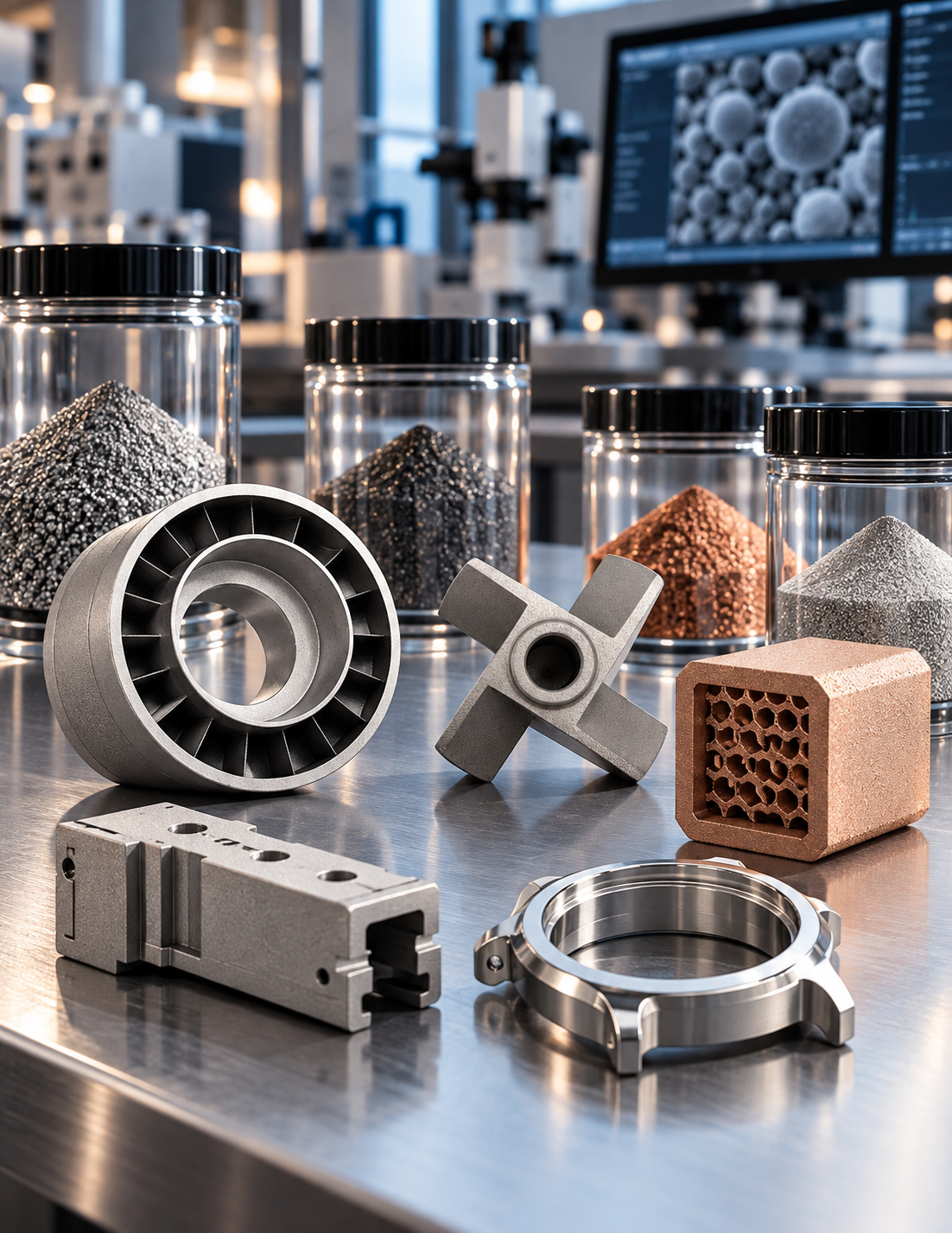
Two powders can both be IN718, Ti-6Al-4V, or another established alloy while differing in particle size distribution, morphology, density, surface condition, and flow behavior. Those differences can affect how the material performs in the manufacturing process even when the underlying alloy chemistry meets the same specification.
The question therefore shifts from "Which alloy do I need?" to "Which form of this alloy does my process need?"
Let the Manufacturing Process Narrow the Field
This is where many of the fundamentals we've covered throughout this series come together.
LPBF generally needs powder capable of forming thin, consistent layers while supporting stable interaction with the laser and melt pool. Binder jetting places additional emphasis on packing behavior, green-part formation, and subsequent sintering. Powder-fed DED introduces another set of requirements because particles need to move reliably through a feeder and carrier-gas delivery system before reaching the deposition zone.
These processes don't ask the same things of their feedstock.
That is why transferring a powder specification from one AM technology to another can be problematic. Even when the alloy is identical, the PSD and other powder characteristics may need to change.
The machine matters too. Recoater design, layer thickness, feeder architecture, process parameters, and equipment-specific material requirements can all influence what constitutes an appropriate powder.
PSD Is a Matching Exercise
Particle size distribution is one of the clearest examples of why powder selection is application-specific.
It can be tempting to look for a standard cut and assume that anything within that range will behave similarly. In practice, the full distribution matters.
Fine particles can support thin layers and fill spaces between larger particles, but increasing the proportion of fines can also increase cohesion and affect flow. Fines also increase surface area relative to volume which can raise oxygen levels, especially in reactive alloys. Coarser particles may flow differently and can be well suited to processes such as DED, but they need to be compatible with the delivery system and available energy input.
Neither fine nor coarse is inherently better.
Even narrow versus broad distributions involve tradeoffs. The appropriate choice depends on the balance of spreading, packing, feeding, layer thickness, and downstream processing required by the application.
Don't Select Powder One Metric at a Time
This may be the most important lesson from the entire Metal Powder Fundamentals series.
Powder properties interact.
PSD affects packing and flow. Morphology affects particle interaction and spreadability. Surface condition can influence behavior during processing. Chemistry affects the material response and ultimately the properties of the finished component.
Optimizing one characteristic without considering the others can therefore lead to the wrong conclusion.
A powder with excellent flow data isn't necessarily the best powder for a process. Neither is the powder with the narrowest PSD, the highest apparent density, or the most spherical-looking particles.
Good feedstock selection is about balance.
Think About the Application's Risk and Qualification Requirements
Not every printed component needs the same level of material control.
A prototype used for fit checks has very different consequences of failure from a flight-critical aerospace component, medical implant, or part operating inside an industrial gas turbine.
As application criticality increases, so does the importance of traceability, lot consistency, defined material specifications, testing, and process qualification. In some programs, changing powder suppliers or feedstock characteristics may have qualification implications even if the nominal alloy remains unchanged.
That means material selection should consider where the program is headed, not simply where it is today.
A powder that works for early development may not be the best choice if its availability, consistency, documentation, or production scalability can't support the eventual manufacturing requirement.
Availability Is a Material Characteristic Too
This isn't something you'll find in a particle size analysis, but it matters once production begins.
A technically excellent powder isn't particularly useful if it can't be supplied reliably in the quantities and configurations a program requires.
Lead times, batch flexibility, lot-to-lot consistency, feedstock availability, and the supplier's ability to support future requirements all become part of the decision as an application scales.
This is particularly relevant for specialty alloys and emerging applications, where customers may need smaller development quantities, nonstandard PSDs, or material configurations that don't fit comfortably within traditional large-batch powder production models.
The commercial side of powder selection shouldn't override technical requirements. But it shouldn't be separated from them either.
The Supplier Can Be Part of the Engineering Decision
Powder selection becomes easier when the relationship with the supplier extends beyond choosing a product number from a catalog.
A capable powder partner should be able to discuss the application, manufacturing process, desired PSD, material requirements, and likely tradeoffs. In development programs, that collaboration can help teams narrow the range of variables they need to test rather than treating powder as a fixed commodity input.
That's particularly relevant when an application falls outside established material-process combinations.
At Continuum Powders, we approach powder selection from that application-first perspective. Our portfolio includes multiple particle size distributions across established alloys, while our specialty alloy development capabilities provide another pathway when an off-the-shelf material doesn't fit the requirement. That flexibility allows the conversation to start with what the customer is trying to accomplish rather than simply what happens to be available in a catalog.
There Is No Perfect Powder, Only the Right Fit
Over the course of this series, we've looked at particle size distribution, D10/D50/D90, morphology, flowability, density, surface chemistry, contamination, characterization, powder reuse, and the requirements of several different additive manufacturing processes.
The common thread running through all of them is context.
No powder characteristic exists in isolation, and no specification can tell you whether a material is right without understanding how and where it will be used.
Choosing the right metal powder means connecting material characteristics to the machine, process, part, qualification strategy, and eventual production requirements.
That's a more complicated answer than simply choosing an alloy and PSD.
But it's also how additive manufacturing moves from making a successful part once to making it successfully again and again.