In additive manufacturing, powder flowability is one of the most important factors influencing process stability. Whether powder is being spread across a build plate, fed through a nozzle, or packed into a powder bed, consistent flow behavior helps ensure uniform layers and repeatable part quality.
Flowability, however, is not a standalone property. It emerges from the interaction of several powder characteristics, most notably particle size distribution (PSD) and particle morphology. Understanding how these properties work together provides valuable insight into why some powders spread easily and predictably while others lead to inconsistent builds or feeding challenges.
This article explores how particle size and shape influence powder flow behavior and why both must be considered when selecting powders for additive manufacturing processes.
What Is Powder Flowability?
Powder flowability refers to how easily particles move relative to one another under gravity or external forces. In additive manufacturing systems, flowability affects how powders spread across the build platform, refill recoating systems, or travel through powder delivery mechanisms.
Poor flowability can lead to uneven powder layers, inconsistent deposition, or interruptions in material delivery. In contrast, powders with good flow behavior tend to form uniform layers and support stable process conditions.
Flowability is often measured using standardized tests such as Hall flow rate, Carney flow, or angle of repose, but the underlying behavior is largely governed by particle interactions.
The Role of Particle Size Distribution
Particle size distribution plays a significant role in determining how powders move and settle.
Fine particles increase surface area and can introduce cohesive forces between particles, which may reduce flowability. These cohesive effects can cause powders to clump together or resist movement during spreading.
At the same time, a small fraction of finer particles can improve packing behavior by filling voids between larger particles. The balance between these effects is why PSD must be engineered carefully.
Distributions that contain excessive fines often exhibit reduced flow performance, while distributions with too many coarse particles may create irregular spreading behavior or inconsistent layer formation.
The Influence of Particle Shape
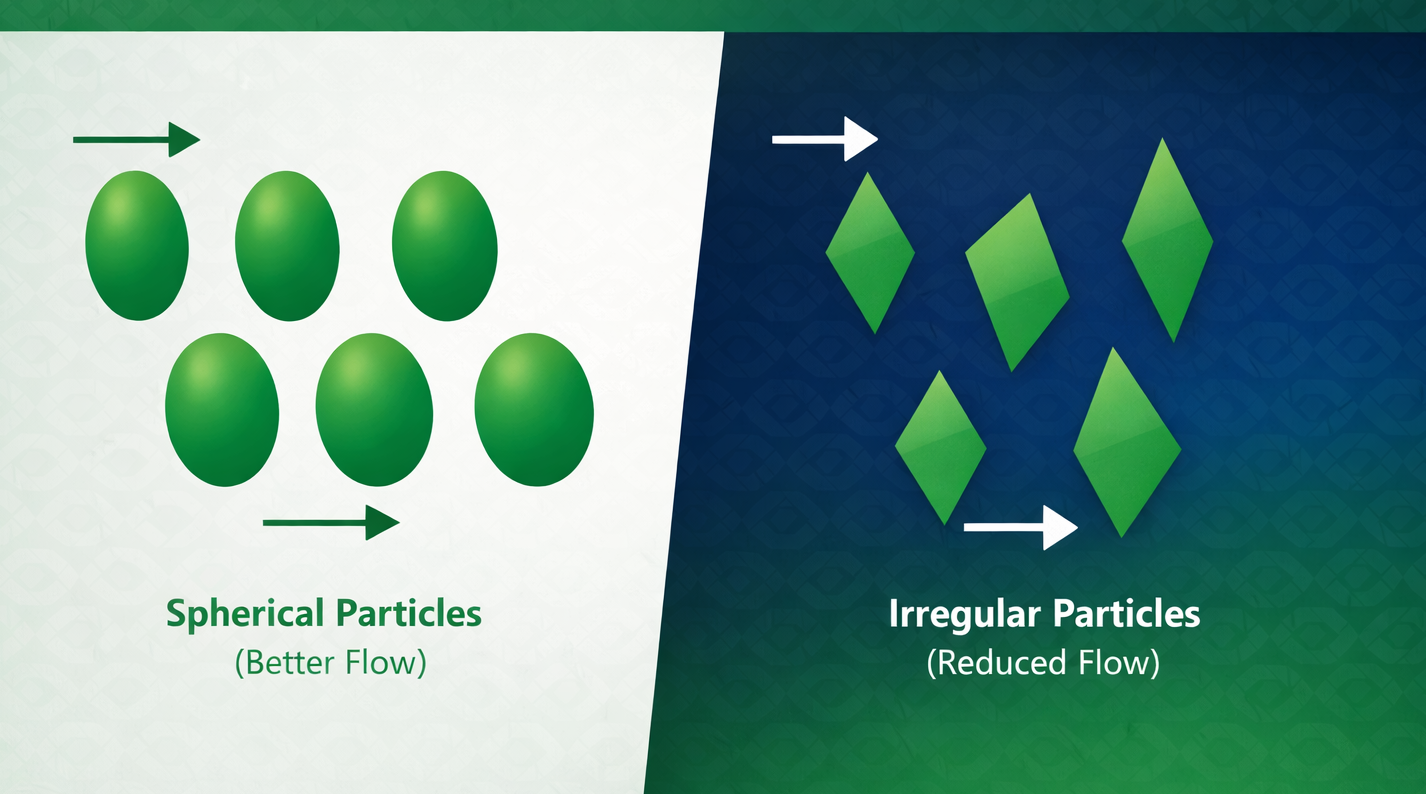
Illustration of how particle morphology influences powder flow behavior. Spherical particles tend to move past one another easily, while irregular particles can interlock and increase friction, reducing flowability.
Particle morphology also plays a major role in powder flow.
Spherical particles typically flow more easily because they roll past one another with minimal friction. Their smooth surfaces reduce resistance during spreading and feeding, helping powders move predictably through AM systems.
Irregular or angular particles tend to interlock or resist movement, increasing internal friction within the powder bed. These particles may lead to inconsistent spreading or unstable powder feeding behavior.
Even small morphological features, such as satellites attached to particle surfaces, can influence flow by increasing roughness and friction between particles.
When PSD and Morphology Interact
Particle size distribution and morphology rarely act independently. Instead, they interact to determine how powders behave during handling and printing.
For example, a powder with a relatively narrow PSD but irregular particle shapes may still flow poorly because friction between particles dominates behavior. Conversely, a powder with a broader distribution but highly spherical particles may exhibit excellent flow characteristics.
These interactions explain why evaluating PSD data alone rarely provides a complete picture of powder performance. Morphology must also be considered to understand how powders will behave in practice.
Flowability Across Different AM Processes
Different additive manufacturing processes place different demands on powder flow behavior.
In laser powder bed fusion, consistent spreading of thin powder layers requires powders that flow smoothly across the recoater blade or roller. Poor flow can lead to incomplete layers or surface defects.
In binder jetting, uniform powder spreading and packing density are critical for producing consistent green parts before sintering.
In directed energy deposition, powders must flow reliably through feeding systems and nozzles to maintain stable deposition.
Although the specific requirements vary, predictable powder movement remains essential across all processes.
Evaluating Flow Behavior in Practice
Powder flowability is typically assessed using standardized testing methods. Hall flow and Carney flow tests measure the time required for a known mass of powder to pass through an orifice. Angle of repose measurements evaluate how powders pile under gravity, providing insight into particle cohesion.
While these tests offer useful indicators, real-world performance depends on the combined effects of PSD, morphology, surface chemistry, and environmental conditions.
For this reason, interpreting flowability results requires considering the broader powder system rather than relying on a single metric.
Flowability as Part of a Powder Strategy
Like particle size distribution and morphology, flowability should be viewed as part of a broader powder strategy rather than a standalone property.
Selecting powders that balance size distribution, particle shape, and surface characteristics helps ensure consistent powder behavior across spreading, feeding, and deposition stages. When these characteristics are aligned with the process requirements, powders tend to behave more predictably — reducing variability as additive manufacturing programs scale toward production.