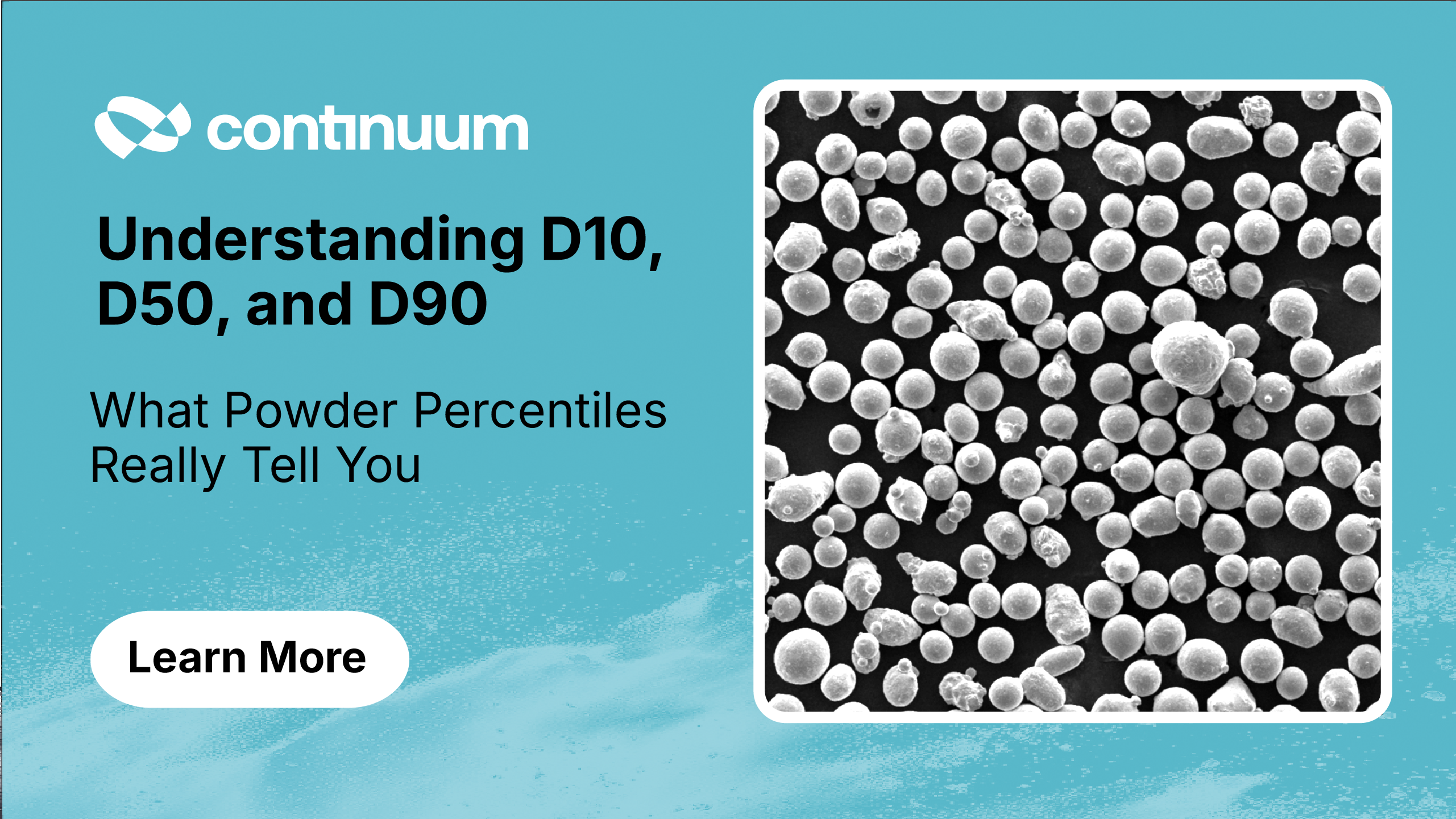
Once particle size distribution (PSD) enters the conversation, three values tend to dominate datasheets, emails, and qualification discussions: D10, D50, and D90. These percentile markers are widely used to describe metal powders, yet they’re often misunderstood — or treated as interchangeable shorthand for powder quality.
In reality, D10, D50, and D90 each tell a different part of the story. Understanding what they represent, how they interact, and what they do not tell you is essential for making informed decisions about powder selection, process stability, and part performance.
This article breaks down what each percentile means in practical terms, how they influence additive manufacturing processes, and why relying on a single value can be misleading.
What Do D10, D50, and D90 Mean?
D10, D50, and D90 are statistical percentiles derived from a particle size distribution measurement. In additive manufacturing, these values are most commonly reported on a volume basis, not by particle count.
When PSD is reported by volume:
- D10 means that 10% of the total powder volume is made up of particles smaller than this size
- D50 represents the median particle size by volume
- D90 means that 90% of the total powder volume consists of particles smaller than this size
This distinction matters because larger particles contribute significantly more material by volume than smaller ones. Volume-based percentiles are generally preferred in additive manufacturing because they more accurately reflect the proportion of powder that is actually contributing to part formation. For example, it takes twenty-seven 15 µm spheres to equal the volume of a single 45 µm sphere. A particle-count–based distribution would treat those 27 small particles as more influential than the single larger one, even though the total material volume is the same. For this reason, particle-count PSD is rarely used in metal additive manufacturing, where material volume — not particle count — governs packing behavior, layer formation, and densification.
Why the D50 Alone Doesn’t Tell the Full Story
Because it represents the median, D50 is often treated as the headline number on powder datasheets. While it’s a useful reference point, D50 by itself provides limited insight into how a powder will actually behave.
Two powders can share the same D50 while having very different distributions by volume. One may contain a meaningful fraction of fine particles, while the other includes a heavier coarse tail. From a processing standpoint, those differences can lead to very different outcomes in flowability, packing density, and layer formation — even though the median value appears identical.
This is why evaluating PSD requires looking beyond the midpoint and considering the full distribution.
The Role of D10: Understanding the Fine Fraction
The D10 value provides insight into the fine end of the particle size distribution, expressed by volume. Even though fines may represent a small volume of particles, they can still contribute meaningfully to overall powder behavior.
Smaller particles can improve packing density by filling voids between larger particles, which can be advantageous for processes such as binder jetting. At the same time, excessive fine material may reduce flowability, increase dusting, or promote agglomeration during handling if exposed to humidity.
From a practical standpoint, D10 helps indicate the lower bound of the distribution, indicating the minimum particle size that has an impact on powder performance.
The Role of D90: Managing the Coarse Tail
At the opposite end of the distribution, D90 reflects the upper bound of the distribution. D90 is often supplemented with sieve analysis for distributions greater than 45µm to account for variation in particle morphology.
Oversized particles can interfere with uniform layer spreading, contribute to surface roughness, or disrupt consistent energy input during printing. In powder bed–based systems, a poorly controlled coarse tail may lead to recoater interference or layer defects. Because of this sensitivity, D95 or D99 may also be used to detect oversized particles.
Monitoring D90 helps ensure that the upper end of the distribution remains compatible with layer thickness, nozzle dimensions, and deposition strategies.
Why the Span Matters More Than Any Single Number
Rather than focusing on individual percentile values in isolation, many engineers evaluate span, which describes the width of the distribution relative to its median:
Span=(D90-D10)/D50
Span provides a normalized view of how narrow or broad a PSD is when reported by volume. A smaller span indicates a tighter distribution, while a larger span reflects a broader range of particle sizes contributing to powder behavior.
Span is particularly useful when comparing powders across suppliers or production lots, where subtle changes in distribution shape may not be obvious from D50 alone.
Percentiles and Process Requirements
Different additive manufacturing processes place different demands on particle size distributions, which is why the relative importance of D10, D50, and D90 can vary.
In laser powder bed fusion, control of the coarse tail is often critical to maintain consistent layer spreading and laser interaction. In binder jetting, the balance between fine and coarse fractions influences packing density and sintering behavior. In directed energy deposition, larger median particle sizes are common, and stable feeding behavior becomes the primary concern.
Understanding which percentile values matter most for a given process helps avoid over-specifying parameters that do not meaningfully improve performance.
Measurement Method Still Matters
It’s also important to remember that D10, D50, and D90 values depend on how PSD is measured. Laser diffraction, sieving, and image-based techniques can yield different results, particularly for powders with irregular morphologies or agglomerates. For this reason, sieve analysis is a common PSD specification for coarse powders.
When comparing powders or qualifying new feedstock, consistent measurement methods and clearly documented test conditions are essential for meaningful comparisons.
Using Percentiles as Context — Not Absolutes
Ultimately, percentile values like D10, D50, and D90 are most useful when they’re treated as part of a broader powder strategy rather than standalone specifications. Interpreting what those numbers mean in practice requires an understanding of how PSD interacts with process conditions, part geometry, and downstream requirements. For advanced manufacturing teams, that often means working alongside powder partners who can offer multiple distributions for the same alloy and help tune PSD based on application needs, which in turn reduces trial-and-error as programs move toward production.