Metal additive manufacturing often leaves powder behind after a build. Depending on the process, alloy, equipment, and qualification requirements, some of that material may be recovered, sieved, blended, tested, and returned to the machine.
That makes powder reuse an attractive operating strategy, but it also creates a deceptively simple question:
How many times can the powder be reused?
There is no universal number.
Powder does not age according to a fixed schedule, and reuse does not affect every alloy or process in the same way. A sound reuse strategy depends on understanding the material’s history, identifying which characteristics could change, and setting acceptance criteria that reflect the application.
The question is less about counting cycles and more about maintaining control.
Reuse Does Not Mean the Same Thing as Reclamation
The language around powder lifecycle management can become confusing, particularly when reuse, recycling, and reclamation are treated as interchangeable.
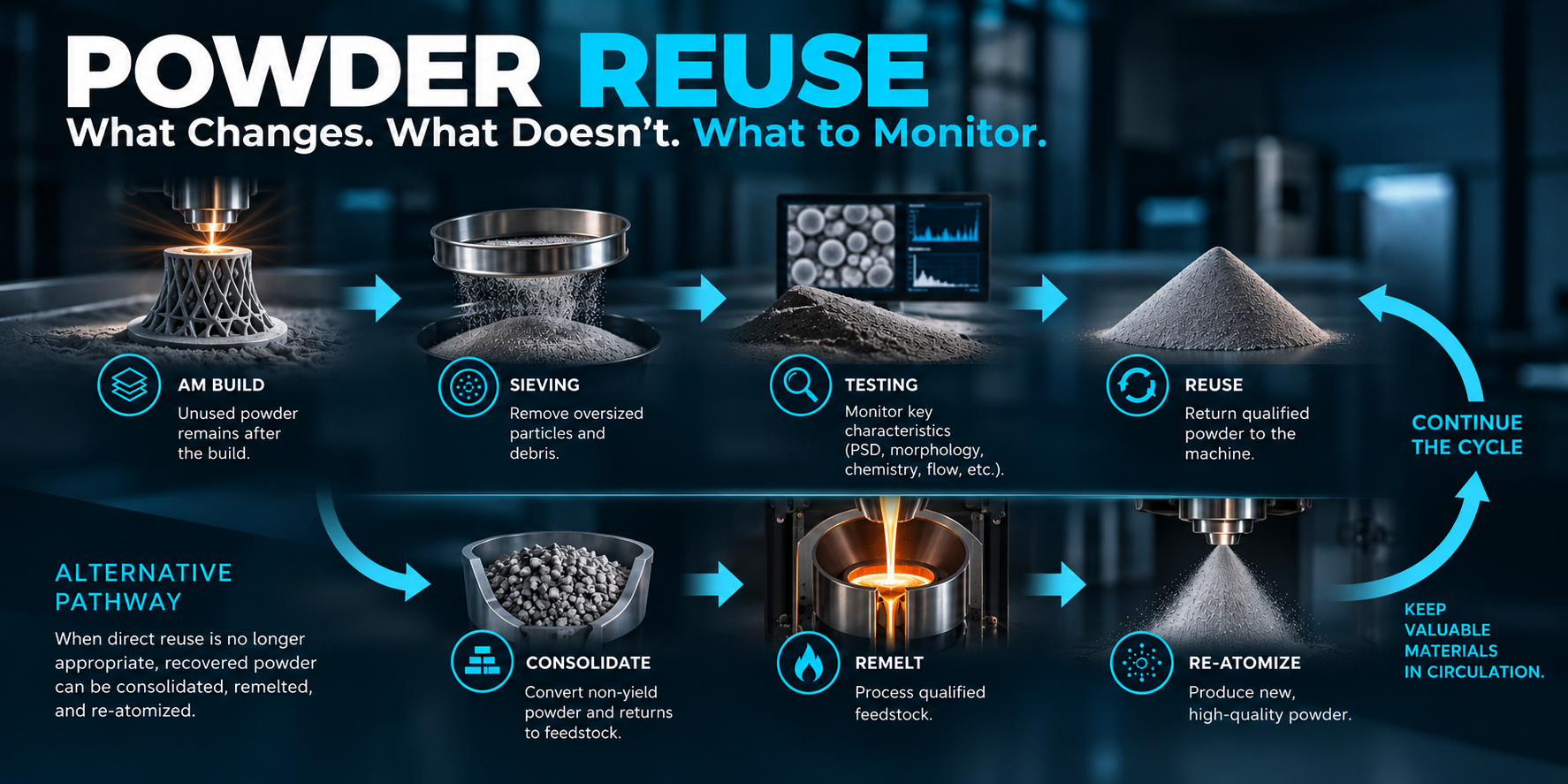
Reuse generally refers to recovering powder from a manufacturing process and returning suitable material to that process, often after sieving or blending. The powder remains powder; it is not melted and remanufactured.
Reclamation or reprocessing takes a different path. Powder, oversized material, production returns, or other qualified metal feedstocks may be consolidated or remelted and converted into a new powder lot. In that case, the material begins a new production cycle rather than continuing through another direct reuse cycle.
The distinction matters because the risks, controls, and qualification approaches are different. Sieving reused powder can remove oversized powder formed from particle agglomeration, but it does not reset powder morphology or the particle size distribution within the upper and lower micron ranges. Remelting and re-atomizing the material creates a new powder, but that process must still control feedstock identity, chemistry, contamination, and final powder characteristics.
What Can Change During Reuse?
Recovered powder may be exposed to heat, process atmosphere, spatter, condensate, handling equipment, and the surrounding environment. The degree of exposure depends heavily on the AM process and machine architecture.
In powder bed fusion, for example, particles near the build zone may experience very different conditions from powder farther away. Recovered material may contain partially fused particles, agglomerates, spatters, or foreign debris. This not only changes the particle size distribution but changes the powder morphology as well. Repeated handling and sieving can also change the balance of fine and coarse material within the usable fraction.
Chemistry may shift as well. Reactive alloys can be particularly sensitive to oxygen, nitrogen, hydrogen, or moisture exposure, although the direction and magnitude of any change must be established through measurement rather than assumed. Some studies report measurable changes after repeated use, while others find that specific powders remain within established limits under controlled conditions.
That variability is precisely why blanket rules are unreliable.
Powder Can Remain Usable Without Remaining Identical
A reused powder does not necessarily need to be identical to virgin powder to remain fit for purpose. It does, however, need to stay within limits that support consistent processing and part performance.
That distinction is important.
Changes in PSD or morphology may be acceptable if they do not meaningfully affect spreading, feeding, melting, density, surface finish, or mechanical properties. Conversely, a powder may still meet a broad material specification while showing enough process drift to create concern for a tightly controlled application.
This is where qualification strategy matters. A development program, an internal tooling application, and a flight-critical component will not necessarily use the same acceptance criteria or sampling plan.
Reuse decisions should reflect the risk associated with the application, not just the economic value of the remaining powder.
Sieving Helps, but It Is Not a Complete Reuse Strategy
Sieving is an important part of many powder recovery workflows. It can remove oversized particles, fused material, and some forms of debris before recovered powder is returned to service.
But sieving only separates material by size.
It cannot confirm alloy identity, detect every foreign contaminant, restore altered surface chemistry, or determine whether the powder will perform consistently in the machine. Nor does it explain how multiple recovered lots should be blended with virgin or previously used powder.
A defensible reuse program therefore needs more than a sieve. It needs documented handling procedures, traceability, representative sampling, defined blending rules, suitable testing, and clear criteria for accepting, conditioning, redirecting, or retiring material.
ASTM has published guidance specifically addressing powder reuse variables and sampling strategies for powder bed fusion, reflecting the growing recognition that reuse needs to be managed as a controlled material system rather than an informal shop-floor practice.
What Should Be Monitored?
The appropriate test plan depends on the alloy, process, application, and known failure modes. In many programs, attention centers on particle size distribution, morphology, flow or spreadability, apparent density, chemistry, moisture, and evidence of contamination.
Not every property must be tested after every build. The objective is to create a monitoring plan capable of detecting meaningful drift before it affects production. That may involve routine in-house checks supported by periodic laboratory testing, along with tighter controls when the material is used in a qualified or safety-critical application.
Traceability is what gives those measurements meaning. Without a reliable record of lot identity, build exposure, recovery, blending, sieving, and testing, it becomes difficult to connect a change in powder behavior to its source.
When Direct Reuse Is No Longer the Best Path
Powder that is no longer suitable for direct reuse does not necessarily have to become waste.
It may contain valuable alloy content even if its PSD, contamination risk, or exposure history makes another machine cycle inappropriate. Oversized fractions, out-of-spec powder, and other returns may be candidates for controlled consolidation, remelting, and re-atomization, provided their identity and chemistry can be managed.
This is where direct reuse and circular powder manufacturing begin to complement each other.
Continuum Powders supports broader material lifecycle through technologies designed to return qualified metal feedstocks to productive use. Our Direct Powder Feeder can reintroduce non-yield powder into the atomization process, while the Consolidator converts eligible powders and returns into a form suitable for remelting. Rather than assuming every recovered powder should continue through another build, the aim is to identify the most appropriate next pathway for the material.
A Reuse Strategy Should Be Based on Evidence, Not a Cycle Count
There is no responsible universal answer to how many times a metal powder can be reused.
The answer depends on what the material has experienced, how it has been managed, what the data shows, and what the final application requires. A fixed cycle limit may be part of a conservative internal procedure, but it should not be mistaken for a law of powder behavior.
The more durable approach is to establish a documented reuse strategy that defines the powder’s history, monitors relevant changes, and provides a clear off-ramp when direct reuse is no longer appropriate.
When done well, powder reuse is not simply a cost-saving measure. It is a disciplined form of material management that can support consistency, reduce avoidable loss, and keep valuable metals in productive circulation.