When evaluating metal powders for additive manufacturing, engineers frequently encounter two density measurements on powder datasheets: apparent density and tap density. While these values may appear similar at first glance, they describe different aspects of how powders pack and behave during handling and processing.
Understanding the difference between these two metrics provides insight into powder packing behavior, flow characteristics, and how powders may perform in additive manufacturing systems.
What Is Apparent Density?
Apparent density measures the bulk density of a powder when it is poured into a container without any external compaction. The powder settles naturally under gravity, filling the available volume according to its particle size distribution, shape, and flow behavior.
Because no external forces are applied, apparent density reflects how powders behave during processes such as powder spreading or filling.
In additive manufacturing, apparent density can provide insight into how powders may pack in a powder bed or how consistently they fill build areas during recoating.
What Is Tap Density?
Tap density measures the density of a powder after the container holding the powder has been mechanically tapped or vibrated many times. This tapping process allows particles to settle more tightly, reducing void spaces between them.
Tap density therefore reflects how tightly particles can pack when external energy is applied.
In many cases, tap density is higher than apparent density because tapping allows particles to rearrange and occupy available space more efficiently.
What the Difference Between Them Reveals
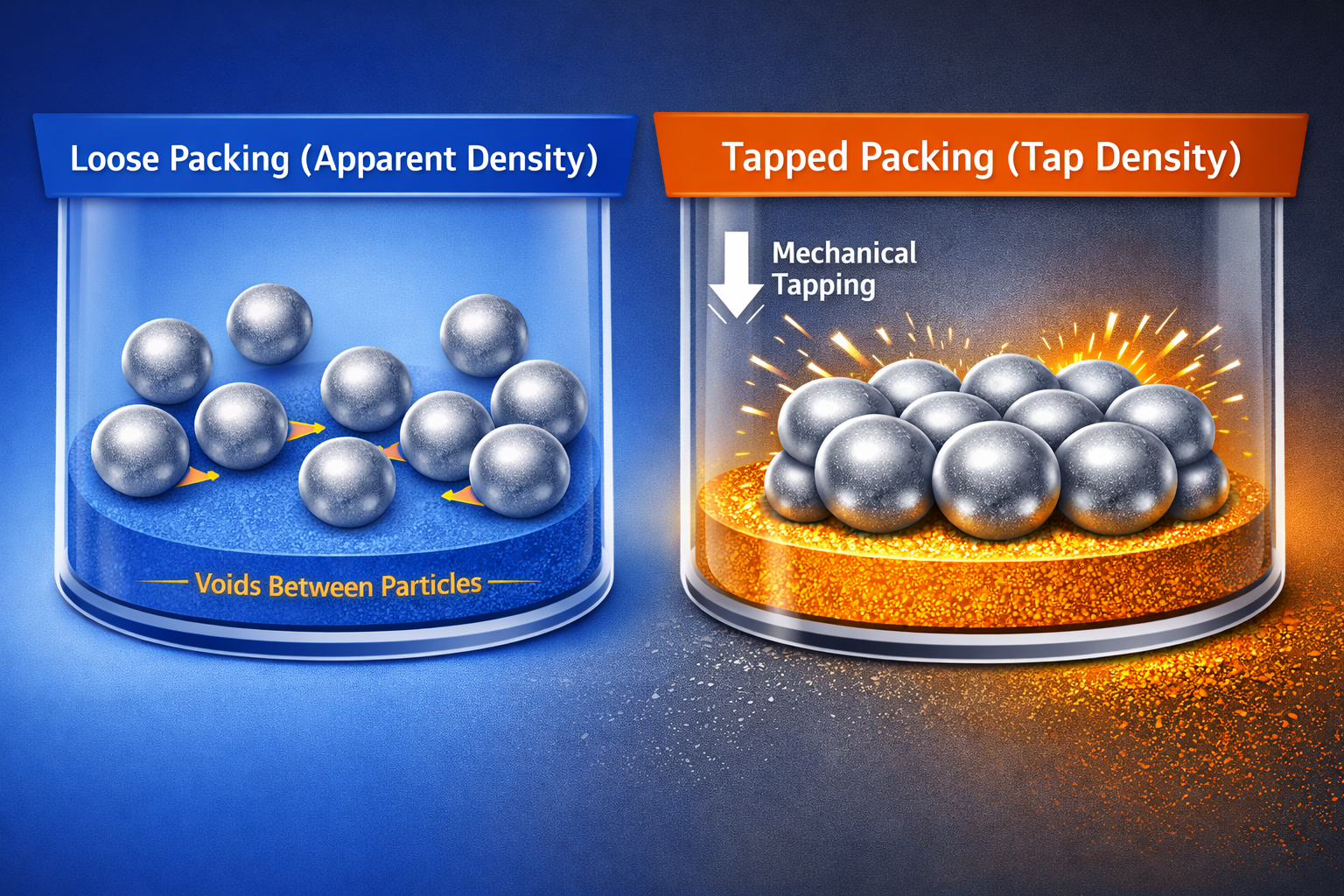
Illustration of powder packing behavior under loose (apparent density) and mechanically tapped conditions (tap density). Mechanical tapping allows particles to rearrange and reduce void space, increasing bulk packing density.
The difference between apparent density and tap density provides insight into how compressible a powder is.
Powders with a large difference between the two values tend to be more compressible, meaning particles can rearrange significantly when energy is applied. This may indicate a broader PSD, irregular particle shapes, or higher internal friction.
The ratio between the Tapped Density and Apparent Density of a powder is known as the Hausner ratio. The Hausner ratio provides insight into powder flowability. Powders with a higher Hausner ratio typically have less free flowing characteristics, while powders with a lower Hausner ratio closer to 1 are free flowing with minimal cohesion.
Powders with smaller differences between apparent and tap density often contain more uniformly shaped particles that pack consistently even without external compaction.
Why Density Metrics Matter in Additive Manufacturing
Density measurements influence several aspects of additive manufacturing.
Higher apparent density can support more consistent powder spreading and packing in powder bed processes. Tap density can provide insight into how powders behave when compacted during certain handling or processing steps.
In processes such as binder jetting, packing density influences the green density of printed parts, which can affect shrinkage and dimensional accuracy during sintering.
In other processes, density measurements may help indicate how powders will behave during transport, storage, or feeding.
Interpreting Density Metrics Alongside Other Powder Properties
While apparent and tap density provide useful information, they should not be interpreted in isolation. Particle size distribution, morphology, flowability, and surface condition all influence how powders pack and behave.
Evaluating density metrics alongside these other characteristics helps build a more complete picture of powder performance.
By understanding how powders pack under both natural and compacted conditions, engineers can better anticipate how materials will behave across different stages of the additive manufacturing workflow.