Defense manufacturing is entering a period where speed, flexibility, and resilience matter as much as scale.
For years, the industrial base conversation has focused on production capacity: more machines, more factories, more output. That focus is important. But for many advanced defense and aerospace programs, the limiting factor is not always the ability to make the final part. It is the ability to develop and qualify the right material for the application.
That is especially true as defense platforms become more specialized. Unmanned systems, advanced propulsion, hypersonics, aerospace components, and next-generation missile programs all place extreme demands on materials. These applications often require alloys that can perform in highly specific thermal, mechanical, or corrosive environments.
In other words, the future of defense manufacturing will depend not only on how quickly we can build parts, but how quickly we can develop the materials those parts require.
This is where small-batch alloy development is becoming strategically important.
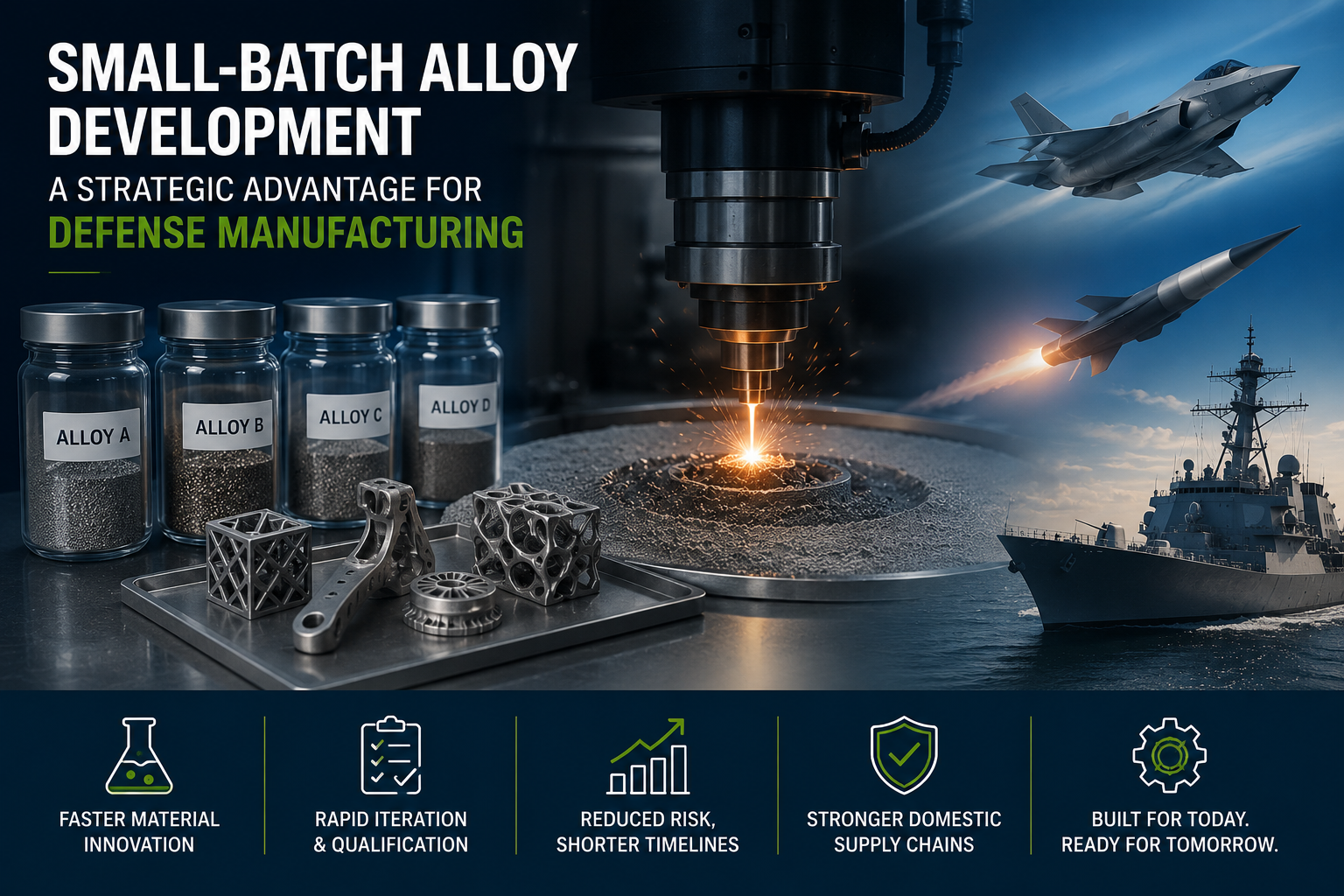
Traditional metal production infrastructure has largely been optimized for volume. That model is essential for mature, high-demand materials, but it does not always match the needs of emerging defense programs. Early-stage programs may require limited production runs, proprietary chemistries, rapid iteration, or multiple alloy variations before moving into qualification and scale-up.
Small-batch alloy development gives engineers a more practical pathway. It allows teams to evaluate new chemistries, refine material performance, and generate application-specific data without committing to large production volumes too early. That flexibility can reduce risk, shorten development timelines, and help promising materials move more efficiently from concept to production.
It also supports a broader national priority: strengthening the domestic defense supply chain.
Resilient manufacturing does not begin at final assembly. It begins much earlier, with access to trusted material sources, qualified powder, traceable feedstocks, and production partners capable of supporting both innovation and scale. As defense and aerospace manufacturers continue to prioritize domestic sourcing, the ability to develop advanced materials within a secure and responsive supply chain will become increasingly valuable.
This shift is particularly important for additive manufacturing. As AM moves further into production applications, material availability will play a larger role in determining what can be qualified, scaled, and deployed. The next wave of defense applications may not rely only on standard commercial alloys. Many will require tailored materials developed for specific performance requirements.
That creates an opportunity for the industry.
By investing in more flexible material development models, manufacturers can support faster innovation without sacrificing quality, traceability, or long-term production readiness. They can also make better use of high-value feedstocks, strengthen domestic sourcing options, and create more resilient pathways from early alloy development to qualified production.
For the defense industrial base, this is not simply a materials issue. It is a readiness issue.
Companies that can move quickly, collaborate closely with engineering teams, and produce advanced materials at the right scale will help define the next generation of defense manufacturing. Small-batch alloy development gives the industry a way to move faster, qualify smarter, and build more resilient supply chains for the programs that matter most.
The future of defense manufacturing will be shaped by more than production capacity. It will be shaped by materials agility.