There’s a long precedent in metal additive manufacturing's development where material consumption was relatively easy to overlook.
A machine producing prototypes or qualification builds might consume tens of kilograms at a time. Powder availability mattered, but it rarely attracted the same attention as laser count, build speed or machine utilization.
But we’re starting to see that production changes that equation.
As manufacturers deploy larger systems, add more lasers and move qualified applications into recurring production, the amount of material flowing through the manufacturing system increases with them. Eventually, improving printer productivity without considering powder supply simply moves the constraint upstream.
More productive machines create a material challenge
The industry's equipment roadmap is clearly moving toward greater throughput. Multi-laser architectures and larger build envelopes are designed to produce more hardware per machine and make additive manufacturing economical across a wider range of applications.
Defense provides an increasingly visible example. KONGSBERG recently announced investments in multi-laser metal AM systems as it builds capacity for product qualification and flyaway hardware. VulcanForms and Specter Aerospace, meanwhile, are developing manufacturing capacity intended to move air-breathing hypersonic systems toward scaled production.
These are encouraging signs for industrial AM. But higher throughput creates a less glamorous requirement: more material has to be available, consistently, when production needs it.
The challenge isn't simply producing enough kilograms. Those kilograms have to arrive with the chemistry, particle size distribution, morphology and other characteristics expected by the manufacturing process. As programs scale, that consistency also has to persist across powder lots and potentially across multiple machines and facilities.
Powder economics look different at production scale
Material utilization also becomes more consequential as volumes increase.
Atomization does not inherently produce every particle in the exact size range required by a particular process. Different applications can consume different portions of the resulting particle size distribution, which means the economics of powder production are influenced by how effectively those fractions can be used.
The same is true inside the factory. Powder that doesn't become part of a finished component is not necessarily waste. Depending on the process, alloy and condition of the material, unused powder and other eligible metal streams may retain significant value.
At development scale, inefficiencies can be relatively easy to absorb. At production scale, small losses multiplied across hundreds or thousands of builds become operating costs.
That makes powder lifecycle management increasingly relevant to the economics of AM production, not just its sustainability profile.
Scaling isn't always a straight line
Another complication is that production demand rarely moves cleanly from 50 kilograms to five metric tons.
Programs ramp unevenly. Forecasts change. Qualification work continues alongside production. Different processes may require different particle size distributions. New applications emerge while others pause.
That creates an awkward middle ground for materials procurement.
Manufacturers need enough powder to protect production, but committing to very large material campaigns too early can tie up capital and inventory. Suppliers therefore need to provide not only capacity, but flexibility as demand evolves.
Recent commercial activity hints at where the market may be heading. PyroGenesis recently announced an initial Ti-6Al-4V powder order through a U.S. materials distributor that says its potential requirements could eventually reach 1,000 kilograms per month. Importantly, that volume is not yet committed, which itself illustrates the challenge: suppliers need to prepare for scale while customers retain uncertainty around actual demand.
The powder supply chain has to scale with the printer
For powder suppliers, this changes what production readiness means.
At Continuum Powders, we increasingly view production supply as more than the ability to atomize a large quantity of material. Customers may need development quantities first, different particle size distributions as applications evolve, dependable replenishment once production begins, and practical options for recovering eligible material rather than continually replacing it with virgin feedstock.
That same challenge is also shaping how we think about the next generation of our own powder-production technology. We aren't ready to share the details yet, but the work underway on the next generation of our Greyhound platform is focused in part on a question that will become increasingly important as metal AM scales: how does powder production evolve to support significantly greater manufacturing demand without sacrificing the flexibility and material control customers need?
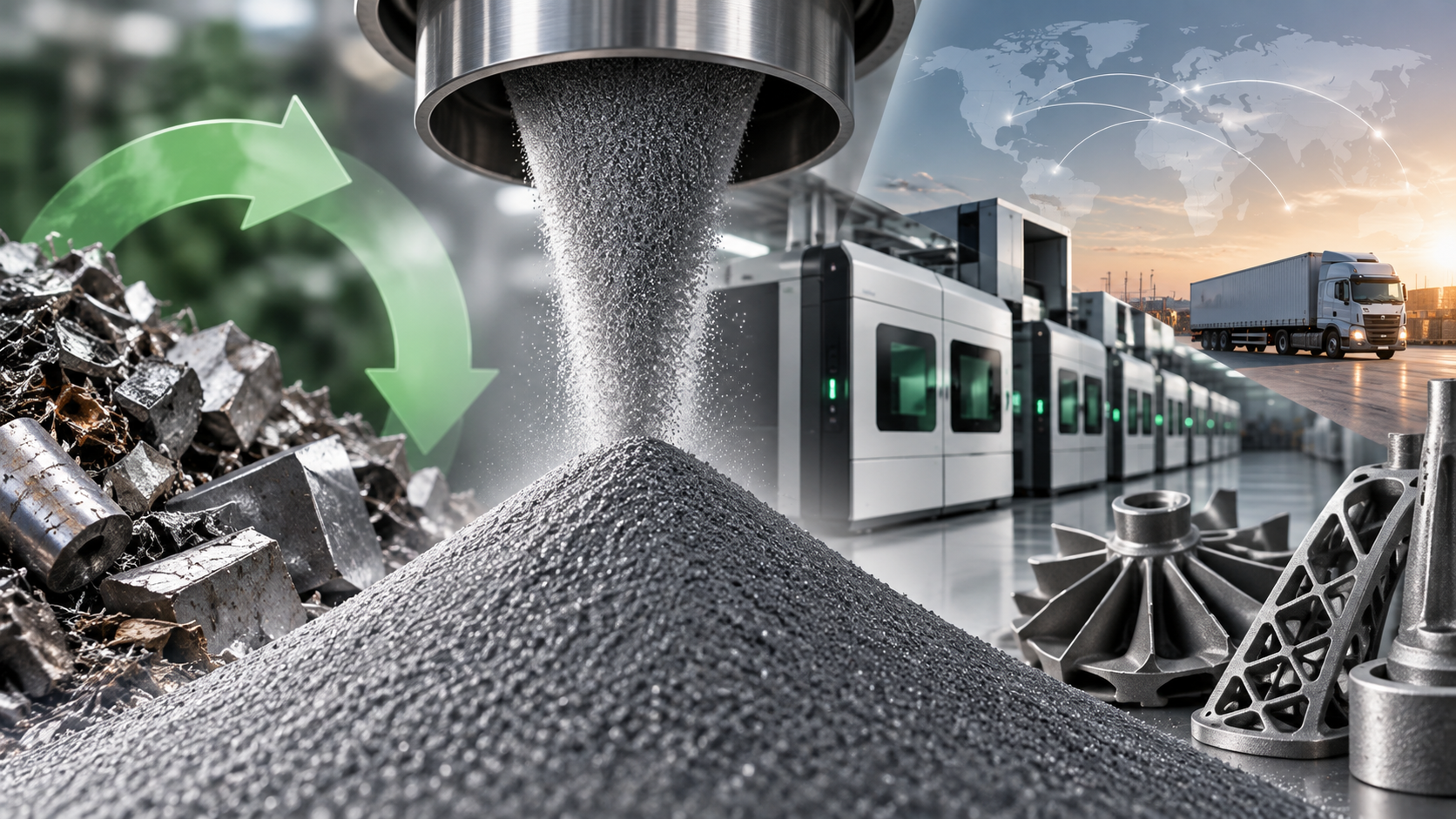
Technologies such as our Direct Powder Feeder and Consolidator address another part of that equation, helping create more flexible pathways for eligible material to move back into the manufacturing loop rather than continually relying on new feedstock.
The objective isn't simply to maximize powder production. It's to make the material system more responsive to the way manufacturing programs actually scale.
Scaling the whole system
Metal AM's productivity race isn't slowing down. Machines will get faster, build volumes will grow and more applications will cross into serial production.
But every additional part still begins with physical material.
For manufacturers, that means production planning increasingly needs to extend upstream. Powder availability, consistency, inventory, utilization, replenishment and recovery all become more consequential as the number of builds increases.
The next phase of AM scale-up therefore won't be determined solely by how quickly a machine can produce hardware. It will also depend on whether the materials infrastructure surrounding those machines can keep pace.
As the industry continues pushing printer productivity forward, there is another question worth asking:
Can the powder supply chain scale just as reliably?