Directed energy deposition is often grouped together with other metal additive manufacturing technologies, but the way it handles powder is distinctly different.
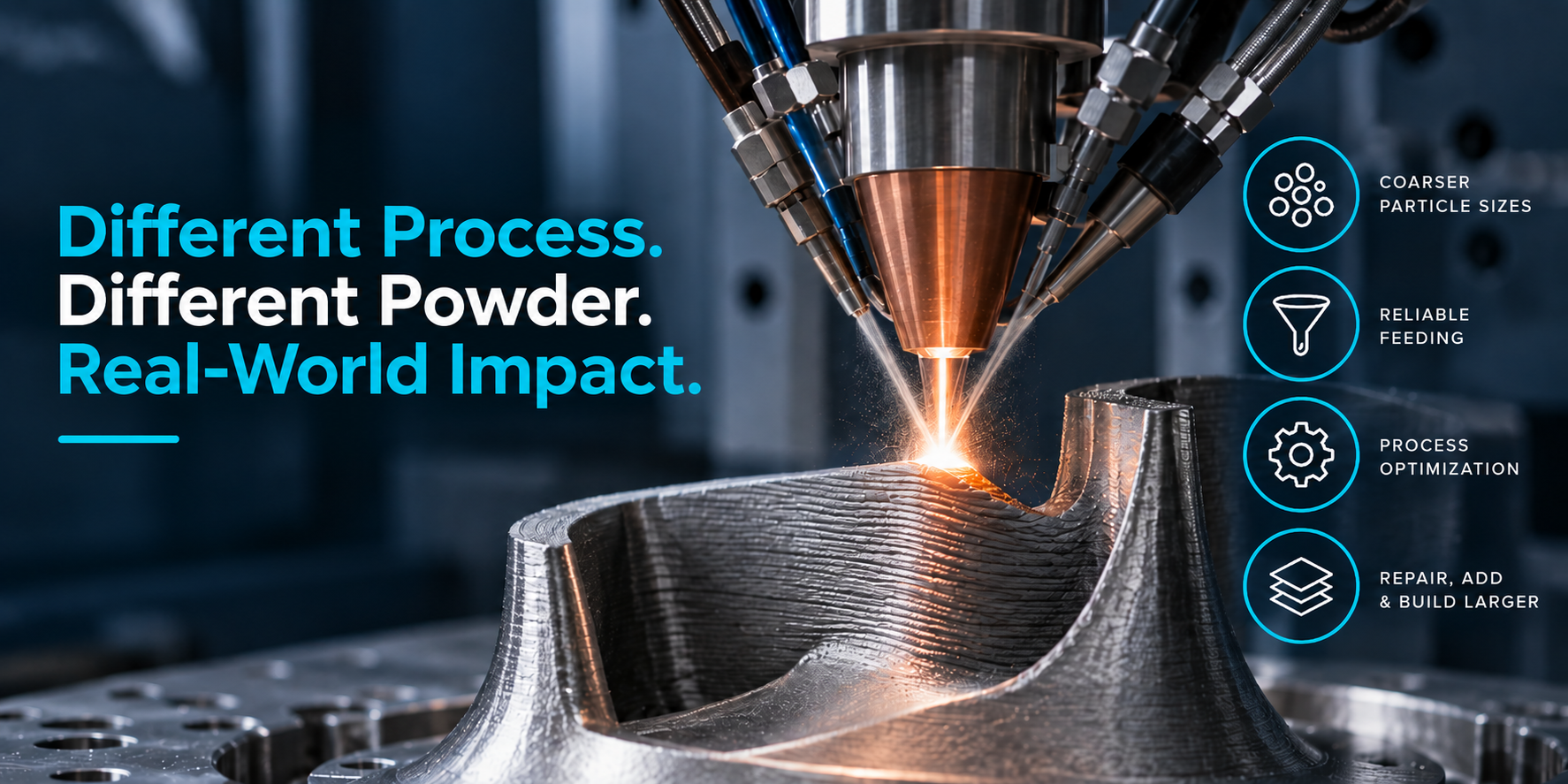
Rather than spreading a uniform layer across a build plate, powder-fed DED delivers material through one or more nozzles directly into a melt pool created by a focused energy source. The material is deposited only where it is needed as the deposition head or workpiece moves. This makes DED well suited to applications such as adding features, repairing components, applying material to existing parts, and building larger geometries.
It also changes what the process needs from its feedstock.
A powder developed for laser powder bed fusion is not automatically the right choice for DED. PSD, morphology, feeding behavior, chemistry, and the way powder travels through the delivery system all need to be considered within the context of the machine and application.
In DED, Powder Has to Travel Before It Can Melt
Powder-fed DED relies on a controlled stream of particles reaching the melt pool at the right place and at the right rate. Before those particles ever interact with the energy source, they must leave the feeder, travel through delivery lines and carrier gas, pass through the nozzle, and converge within the deposition zone.
Every part of that journey matters.
Inconsistent feeding can change the amount of material reaching the melt pool. That can affect bead geometry, deposition rate, dilution, and the stability of the build or repair. A powder that looks acceptable on a general datasheet may still present difficulties if its flow behavior does not match the feeder and delivery system being used.
This is one reason DED feedstock selection should begin with the equipment and deposition strategy rather than with a preferred powder specification carried over from another AM process.
Why DED Often Uses Coarser Powder
Powder-fed DED commonly uses particle size distributions that are coarser, 45-106µm or 45-150µm, than those associated with laser powder bed fusion, 15-45µm. The larger particles are generally better suited to pneumatic delivery and the deposition rates typical of DED, while very fine particles can be more cohesive and difficult to transport consistently. Fine particles are also more likely to be swept out of the deposition zone by carrier gas,
That does not mean coarser is always better. Particles still need to move predictably through the feeder and nozzle, interact effectively with the energy source, and melt within the available residence time. Material that is too coarse for a given system may not fully melt or may reduce deposition efficiency. Excessive fines, meanwhile, can agglomerate, adhere within the delivery system, or behave differently in the carrier-gas stream.
There is no single DED particle size distribution that applies across every machine or application. Equipment configuration, nozzle geometry, carrier-gas conditions, deposition rate, energy input, alloy, and desired feature resolution all influence what will work best.

Feeding Consistency Can Matter More Than a Headline Flow Number
Traditional powder flow tests remain useful for comparing materials and monitoring consistency, but they do not fully reproduce what happens inside a DED delivery system.
DED feedstock is not simply falling through a funnel under gravity. It is being metered and transported through equipment under dynamic conditions. Powder that performs well in a Hall or Carney test may still feed inconsistently if it segregates, bridges, pulses, or interacts poorly with the specific feeder design.
Morphology is part of that equation. Spherical particles generally support smoother movement and more predictable transport than highly irregular particles, which may interlock or create greater resistance. Satellites and agglomerates can also change effective particle behavior, even when the reported PSD appears acceptable.
The more useful question is not whether the powder “flows well” in the abstract. It is whether it can be delivered steadily enough to support a stable melt pool and consistent deposition.
The Powder Stream and Melt Pool Must Work Together
In DED, powder behavior cannot be separated from the thermal process.
Particles need to enter the deposition zone at a rate and trajectory that allow them to interact with the melt pool effectively. Feed rate, travel speed, energy input, stand-off distance, and carrier-gas conditions all influence the result. Changing the powder may therefore require adjustments elsewhere in the process.
This interdependence is especially important when switching suppliers, PSDs, or production lots. Two powders with the same nominal alloy and cut may not behave identically if their morphology, surface condition, density, or distribution shape differs.
For repair and feature-addition applications, chemistry compatibility deserves equal attention. The deposited material must be appropriate for the substrate and intended service conditions, while dilution and thermal history can influence the final composition and microstructure.
DED Values Flexibility, but Not Variability
One of DED’s greatest strengths is flexibility. It can add material to existing components, work across a range of build volumes, and support applications that would be difficult to address through powder bed processes.
That flexibility should not be confused with tolerance for inconsistent feedstock.
Stable deposition still depends on repeatable powder delivery and controlled material characteristics. As DED programs advance from development work into qualified repair or production environments, lot-to-lot consistency becomes increasingly important. A change in feeding behavior can require new parameter work even when the alloy designation remains unchanged.
At Continuum Powders, this application-specific view shapes how we approach DED feedstock. We offer multiple particle size distributions across a range of alloys and can work with customers to align powder characteristics with the delivery system, deposition strategy, and end-use requirements. The goal is not to prescribe one universal DED cut, but to help identify a feedstock that can be delivered and processed predictably within the customer’s actual environment.
The Right DED Powder Is the One That Supports the Whole Process
DED feedstock selection is not simply a matter of choosing a coarser version of an LPBF powder.
The material has to flow through the feeder, travel through the delivery system, reach the melt pool consistently, melt effectively, and produce the required composition and properties. No single datasheet value can confirm all of that.
The most successful programs treat powder and process development as connected decisions. When PSD, morphology, chemistry, delivery conditions, and thermal parameters are aligned, DED can provide the flexibility it is known for without sacrificing the control required for repeatable manufacturing.