Powder flowability is one of those terms that comes up constantly in additive manufacturing conversations. Everyone knows it matters. But once you get into how it’s actually measured — and what those measurements mean in practice — things get less straightforward.
Flowability isn’t a single property. It shows up differently depending on how the powder is handled, spread, or fed into a process. That’s why there isn’t just one test for it, and why interpreting the results requires more context than a single number.
Why Flowability Needs to Be Measured
As we’ve covered in earlier articles in this series, powder behavior is influenced by particle size distribution, morphology, and surface condition. Flowability is where those factors show up in a practical way.
You can often get a sense of how a powder might behave by looking at PSD or SEM images, but measurement gives you something more concrete. It allows you to compare materials, track consistency from lot to lot, and flag potential issues before they show up during printing.
That said, no single test tells the whole story.
Hall Flow: A Useful Starting Point
The Hall flow test is one of the most commonly used methods for evaluating powder flowability. The Hall flow test (ASTM B213) is one of the most commonly used methods for evaluating powder flowability. A 50 g sample is poured into a standardized funnel with a 2.5 mm orifice, and the time it takes for the material to pass through is recorded.
Shorter times generally indicate better flow.
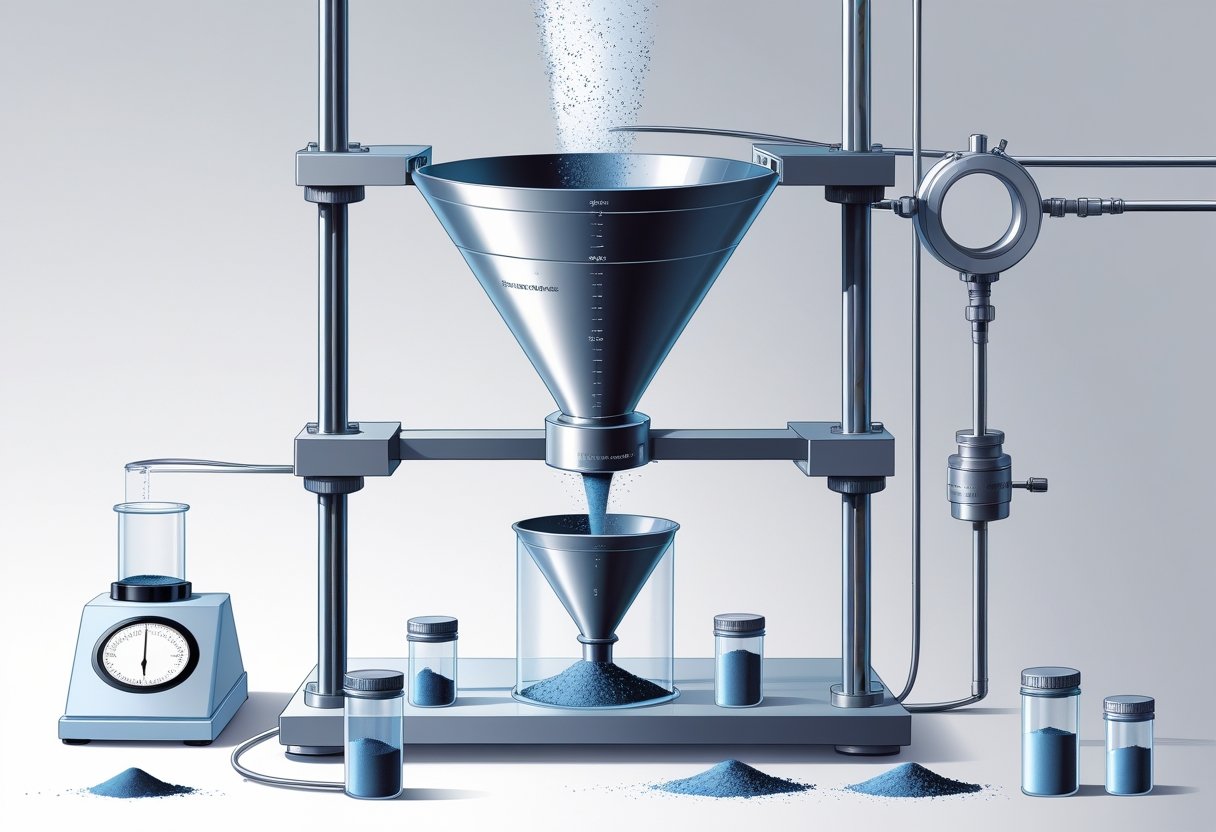
Example of Hall Flow Testing
It’s a simple test, and that’s part of its appeal. For powders that flow easily, it provides a quick baseline for comparison. The limitation is that it only works when the powder actually flows. Very fine or cohesive powders may not pass through the orifice at all, which makes the result less useful in those cases.
Carney Flow: Extending the Range
The Carney flow test (ASTM B964) follows the same basic idea as the Hall test but uses a larger 5 mm orifice. That small change makes it possible to measure powders that wouldn't flow under standard Hall conditions.
In practice, Carney flow is often used when Hall flow isn’t obtainable. Looking at the two together can give a better sense of where a powder sits on the spectrum from free-flowing to more cohesive.
Angle of Repose: A Different Perspective
The angle of repose takes a different approach. Instead of measuring how powder moves through an opening, it looks at how powder behaves when it forms a pile.
As powder is poured onto a surface, it forms a cone-shaped pile. The angle between the surface of that pile and the horizontal surface provides insight into how easily the particles move relative to one another.
Lower angles suggest better flowability, while higher angles point to increased cohesion.
It’s a useful indicator, especially for understanding handling behavior, though it doesn’t directly replicate what happens inside a machine.

Download Brochure
Explore how circular manufacturing is moving from concept to performance. This playbook examines reclaimed feedstock, melt-to-powder processing, and independent benchmarking that shows how reclaimed superalloy powder can support demanding AM applications.
Rotating Drum: Capturing Dynamic Behavior
Hall, Carney, and angle of repose tests all measure powder under static or single-event conditions. Rotating drum testing takes a different approach — it observes powder while it's actually in motion.
In a typical setup, a transparent drum is partially filled with powder and rotated at a controlled speed. A camera captures images of the powder surface as it tumbles, and image analysis software extracts parameters such as the dynamic angle of repose (sometimes called the avalanche angle) and a cohesive index that reflects how uniformly the powder flows versus how much it clumps and slips in discrete avalanches.
What makes this method particularly relevant for AM is that the dynamic conditions inside the drum more closely resemble what powder experiences during recoating. ISO/ASTM TR 52952 specifically explores the correlation between rotating drum measurements and powder spreadability in laser powder bed fusion, which has helped move the technique from a research tool toward broader industrial use.
Rotating drum tests also tend to be more sensitive than traditional methods. They can pick up differences between powders that flow similarly under Hall or Carney conditions but behave differently when spread in thin layers — which is often where lot-to-lot variability shows up in practice.
The trade-offs are equipment cost and the need for more careful interpretation. The data is richer, but a single number is harder to point to, and results can shift with rotation speed, fill volume, and ambient humidity. As with the other tests, rotating drum measurements are most useful when read alongside PSD, morphology, and density data.
What These Tests Actually Tell You
Each test captures a different aspect of how the powder behaves under specific conditions.
Hall and Carney flow focus on how powder moves through a confined opening. Angle of repose reflects how particles interact when they accumulate under gravity. Rotating drum tests capture dynamic flow behavior closer to what occurs during recoating. None of these tests, on its own, captures the full complexity of how powder behaves during a build.
That’s why flowability results should be treated as indicators, not absolutes.
Real-world performance depends on a mix of factors — recoating speed, layer thickness, environmental conditions, and how particles interact with one another.
Connecting Flowability to AM Processes
The importance of flowability shows up differently depending on the process.
In powder bed fusion, flowability directly affects how evenly powder spreads across the build plate. In binder jetting, it influences both spreading and packing behavior, which in turn affects green density and sintering outcomes. In directed energy deposition, flowability determines how consistently powder feeds through delivery systems.
Different processes stress the powder in different ways, but in all cases, inconsistent flow leads to inconsistent results.
Using Flowability Data Effectively
Flowability data becomes more useful when it’s viewed alongside other powder characteristics.
Looking at Hall or Carney flow alone doesn’t tell you why a powder behaves the way it does. Pair that data with PSD, morphology, and density, and the picture becomes much clearer.
That’s typically how engineers approach it — not as a single metric to optimize, but as part of a broader evaluation of powder behavior.
Flowability as Part of a Broader Powder Strategy
Ultimately, flowability measurements are most valuable when they are used as part of a broader understanding of how powders behave in real-world manufacturing environments. Interpreting results from tests such as Hall flow, Carney flow, angle of repose, or rotating drum testing requires context — including how particle size distribution, morphology, and surface condition interact within a given process. For advanced manufacturing teams, this often means working with powder partners who can help evaluate these variables together and align powder characteristics with process requirements, reducing variability as programs move from development to production.