Laser Powder Bed Fusion (LPBF) has become one of the most widely adopted metal additive manufacturing processes for high-performance applications. From aerospace components to medical implants, LPBF offers a combination of geometric freedom and material performance that continues to drive adoption across industries.
But LPBF is also one of the most demanding powder environments in additive manufacturing.
Thin powder layers, tightly controlled laser parameters, and repeated thermal cycling leave little room for variability. Powders that appear acceptable on paper can still create challenges once they enter the machine, particularly as applications move from prototyping to production.
That’s why successful LPBF programs rarely focus on a single powder characteristic. Instead, they depend on understanding how multiple powder properties work together throughout the build process.
Every Layer Matters
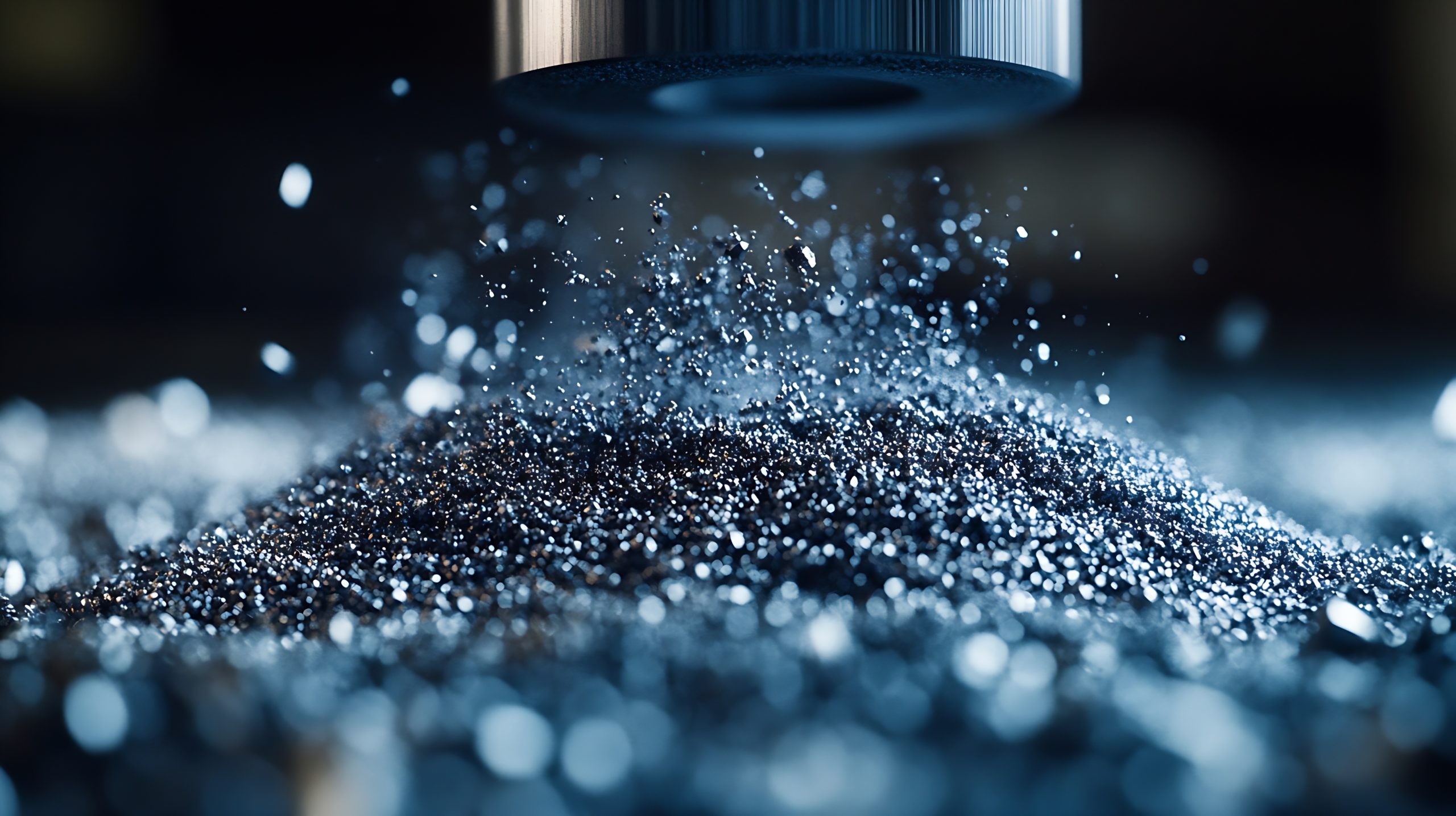
At its core, LPBF is a layer-by-layer manufacturing process. A thin layer of powder is spread across the build platform, selectively melted by a laser, and then followed by another layer. This cycle repeats hundreds or even thousands of times throughout a build.
That repeated layering is what makes powder consistency so important.
If powder spreads unevenly, packs inconsistently, or behaves differently from one layer to the next, those variations can influence melt pool stability, density, dimensional accuracy, and ultimately part quality.
The process has very little tolerance for inconsistency. Small variations that might go unnoticed in other manufacturing methods can become amplified across an entire build.
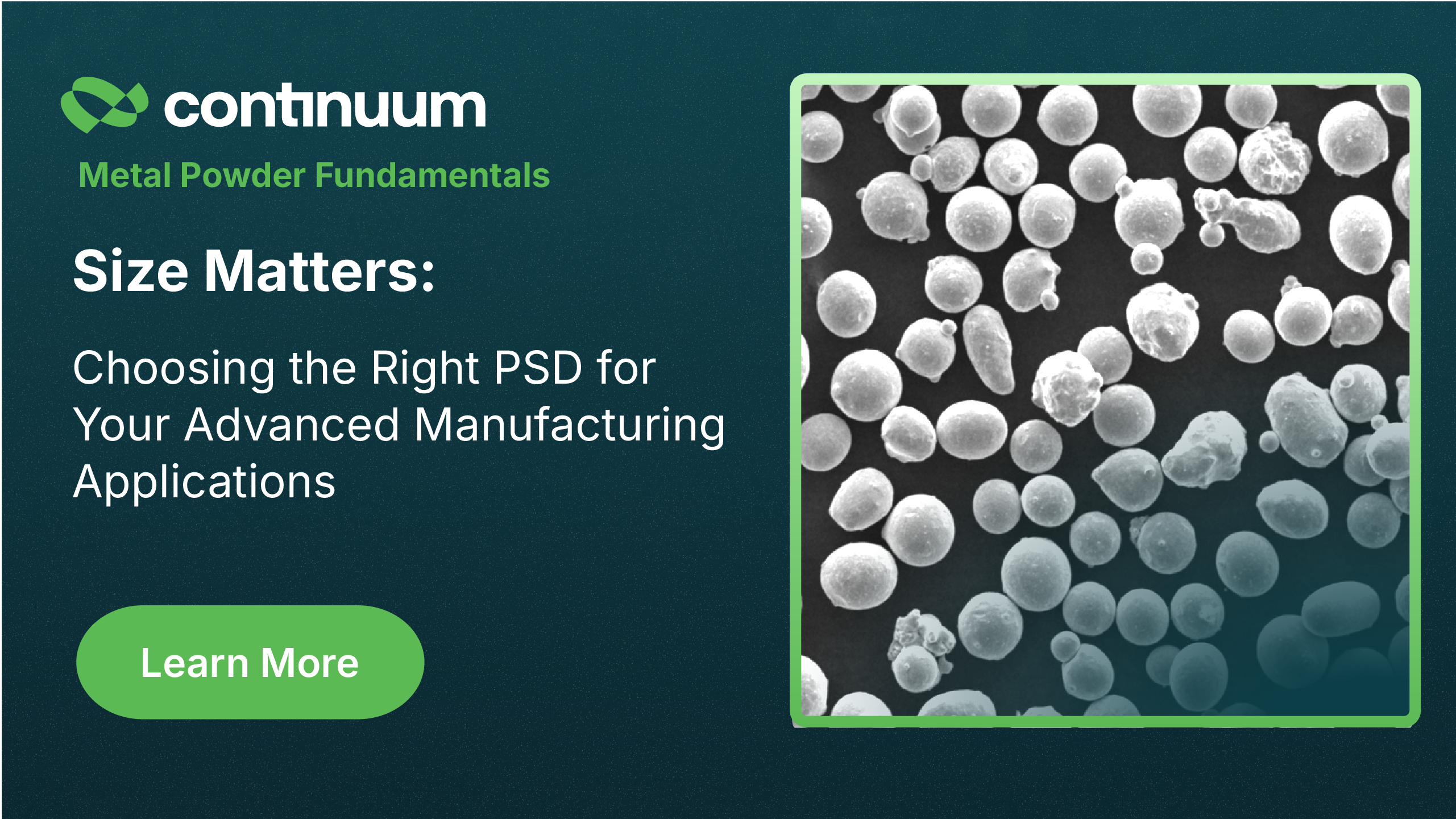
Particle Size Distribution Must Support the Process
Particle size distribution plays a central role in how powders behave during LPBF.
Finer powders often support thinner layers and improved surface finish, which can be beneficial for certain applications. At the same time, finer particles introduce more surface area, which can increase cohesiveness and reduce flowability.
Moving too far in the other direction presents a different set of challenges. Coarser powders generally flow well, but they constrain achievable layer thickness and surface finish. Particles that are large relative to the layer height can drag or streak during recoating, and larger particles simply leave a rougher surface.
The objective is not to maximize or minimize particle size. It is to select a distribution that aligns with the requirements of the machine, the layer thickness being used, and the performance expectations of the application.
Different LPBF systems may favor different PSD ranges, which is one reason there is no universal solution.
Learn more about choosing the right PSD
Why Spherical Morphology Remains the Standard
Particle shape often receives less attention than PSD, but it has a significant influence on powder behavior.
Highly spherical particles tend to flow more consistently and spread more uniformly across the build surface. They also reduce friction and mechanical interlocking between particles, helping create stable dense powder layers.
Irregular particles and excessive satellites can interfere with that process. While a few irregularities are unlikely to determine the success or failure of a build, repeated inconsistencies can influence overall process stability.
This becomes increasingly important as production volumes increase and manufacturers seek greater repeatability across multiple machines and build cycles.
Flowability Is Important — But It’s Not Everything
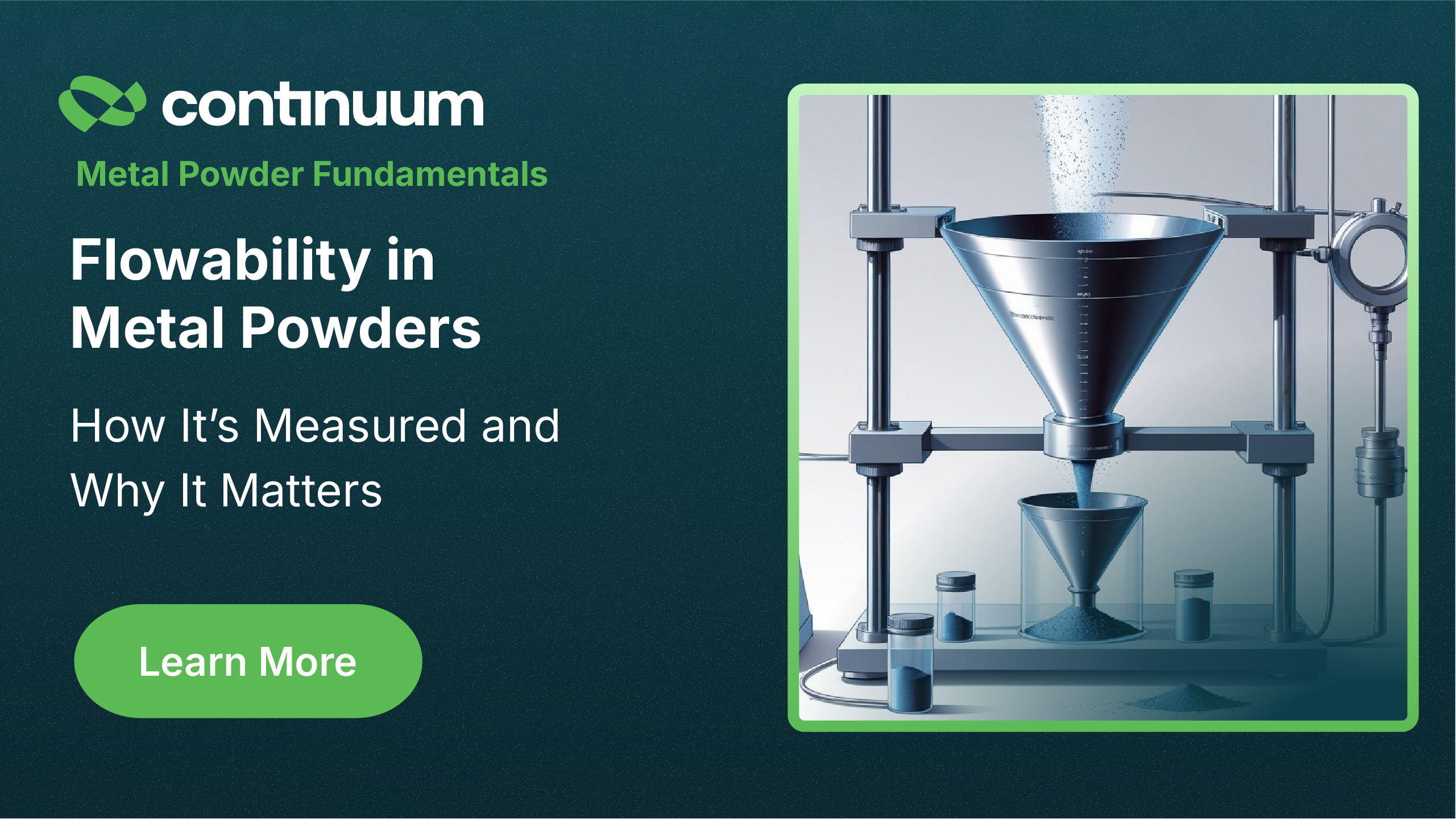
Flowability is often one of the first powder metrics engineers look at when evaluating LPBF feedstock.
That makes sense. Powders must move and spread reliably throughout the process.
However, flowability measurements only tell part of the story.
Hall flow and Carney flow tests provide useful indicators of how powder behaves under standardized conditions, but they do not fully replicate what happens inside a printer. Recoater interactions, environmental conditions, particle morphology, and PSD all influence how powders behave during actual builds.
For that reason, flowability is best viewed as one piece of a larger puzzle rather than a standalone predictor of print performance.
Chemistry Consistency Becomes Increasingly Important
LPBF exposes powder to repeated thermal cycles and localized energy input, making chemistry control particularly important.
Elements such as oxygen and nitrogen can influence mechanical properties, especially in reactive alloys and high-performance applications. Surface condition and oxidation can also affect how powders interact with laser energy during melting.
These considerations become even more important when powders are reused over multiple build cycles.
For production environments, maintaining chemistry consistency over time often becomes just as important as achieving the initial specification.
Repeatability Is the Real Goal
Early-stage additive manufacturing projects often focus on demonstrating that a part can be printed successfully.
Production environments have different objectives.
The challenge is no longer printing one successful part. It is producing the same outcome repeatedly across multiple builds, machines, operators, and time periods.
That level of consistency depends heavily on powder behavior.
At Continuum Powders, this systems-level perspective is central to how we support LPBF customers. Different applications place different demands on powder performance, which is why we offer multiple PSD options across several alloys and work closely with customers to align powder characteristics with process requirements. The objective is not simply to meet a specification, but to help create stable, repeatable manufacturing outcomes.
Balance Wins
There is no perfect LPBF powder.
The materials that perform best are rarely those optimized aggressively around a single metric. Instead, successful powders balance PSD, morphology, flowability, density, chemistry, and process stability in a way that supports consistent performance over time.
As LPBF continues maturing into a true production technology, that balance will only become more important.