For years, the conversation around metal additive manufacturing centered on machines, print quality, and qualification.
Those challenges haven't disappeared—but they're no longer the only ones that matter.
As metal AM continues its transition from prototyping to production, manufacturers are facing a new question:
Where will all the material come from?
As demand for nickel, titanium, copper, and specialty alloys accelerates across aerospace, defense, energy, medical, and emerging AI infrastructure, material strategy is becoming just as important as manufacturing strategy.
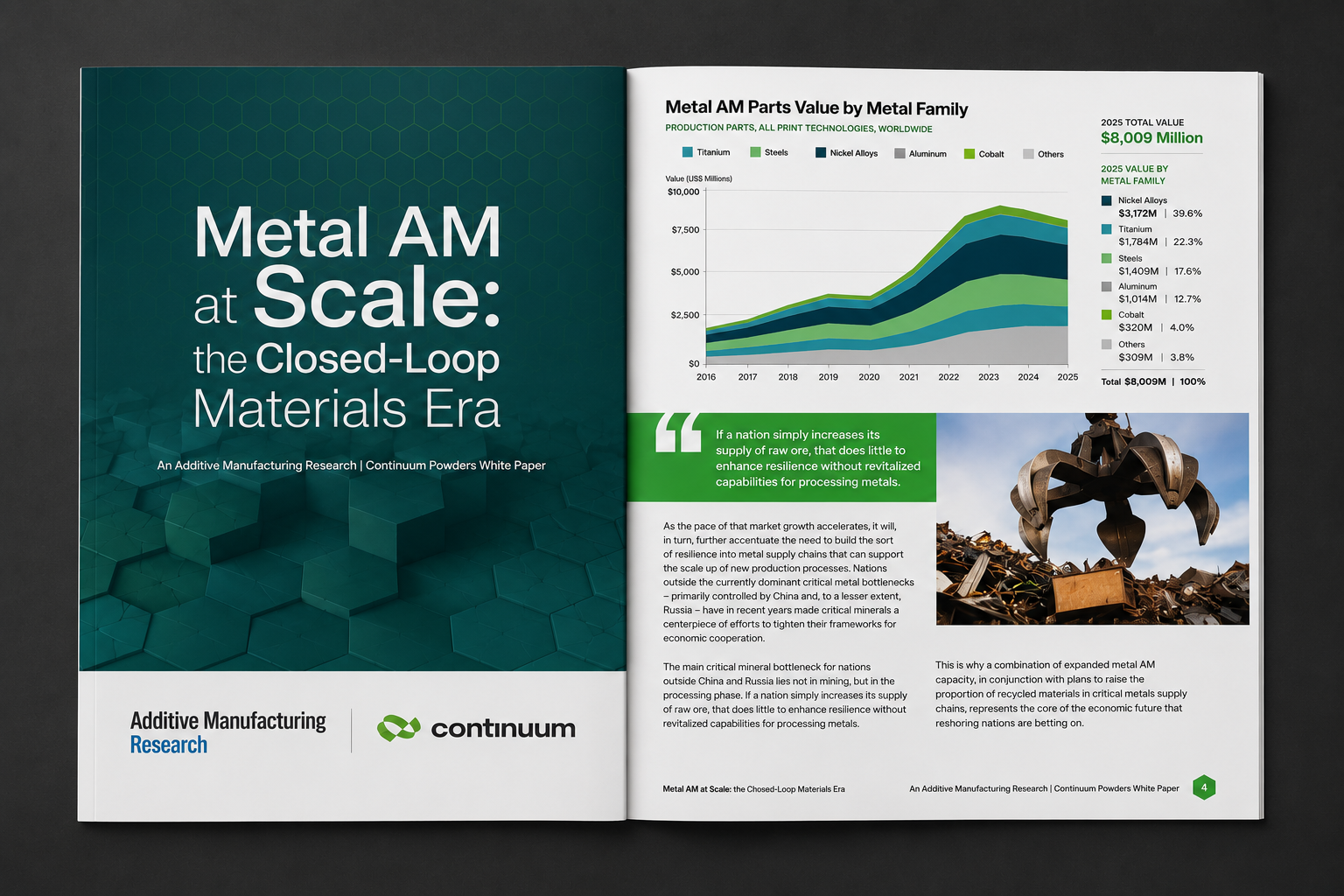
That's the central idea behind our latest white paper, Metal AM at Scale: The Closed-Loop Materials Era, developed in collaboration with Additive Manufacturing Research.
Scaling AM Means Rethinking Materials
The research paints a compelling picture of where the industry is headed.
According to AM Research, the value of powder bed fusion production parts is expected to grow from approximately $6 billion in 2025 to nearly $30 billion by 2034. That's a fivefold increase in less than a decade.
Growth on that scale creates opportunities—but it also creates pressure.
Manufacturers will need reliable access to strategic materials while controlling costs, reducing waste, and minimizing supply chain risk.
That's where closed-loop material ecosystems become increasingly important.
Rather than viewing recycled feedstock solely through the lens of sustainability, forward-looking manufacturers are beginning to see it as a competitive advantage that supports supply resilience, production flexibility, and long-term economics.
What You'll Learn
Inside the white paper, we explore:
- Why material availability is becoming a strategic differentiator for metal AM.
- How demand is evolving across aerospace, defense, medical, AI infrastructure, and consumer applications.
- Why recycling and circular material strategies are moving from "nice to have" to business necessity.
- Real-world examples of organizations already embracing closed-loop approaches.
- What manufacturers should be thinking about today to prepare for tomorrow's production demands.
The future of metal additive manufacturing isn't just about printing more parts.
It's about building resilient material ecosystems that can support production at scale.