Metal powder datasheets are supposed to simplify material selection. In reality, they often do the opposite.
A typical datasheet is packed with numbers: particle size distribution, density values, flow metrics, chemistry ranges, and references to standards or testing methods. For someone experienced with powders, those values can provide a useful snapshot of how a material is likely to behave. For everyone else, it can feel like trying to decode a technical language without much context.
The challenge is that most powder properties don’t mean very much on their own.
A Hall flow value without particle morphology context only tells part of the story. A PSD range without understanding the intended process can be misleading. Even chemistry values require interpretation depending on the application and performance requirements.
That doesn’t make datasheets unhelpful. It just means they work best when viewed as a starting point rather than a final answer.
Start with the Process, Not the Numbers
One of the most common mistakes people make when reviewing powder datasheets is evaluating the material in isolation instead of thinking about the process it’s intended for.
The same alloy can require very different powder characteristics depending on whether it’s being used for laser powder bed fusion, binder jetting, or directed energy deposition. A PSD that works extremely well in one process may create challenges in another.
That’s why the first question shouldn’t be:
“Is this powder good?”
It should be:
“Is this powder appropriate for the process and application?”
Once that framing is in place, the numbers become much easier to interpret.
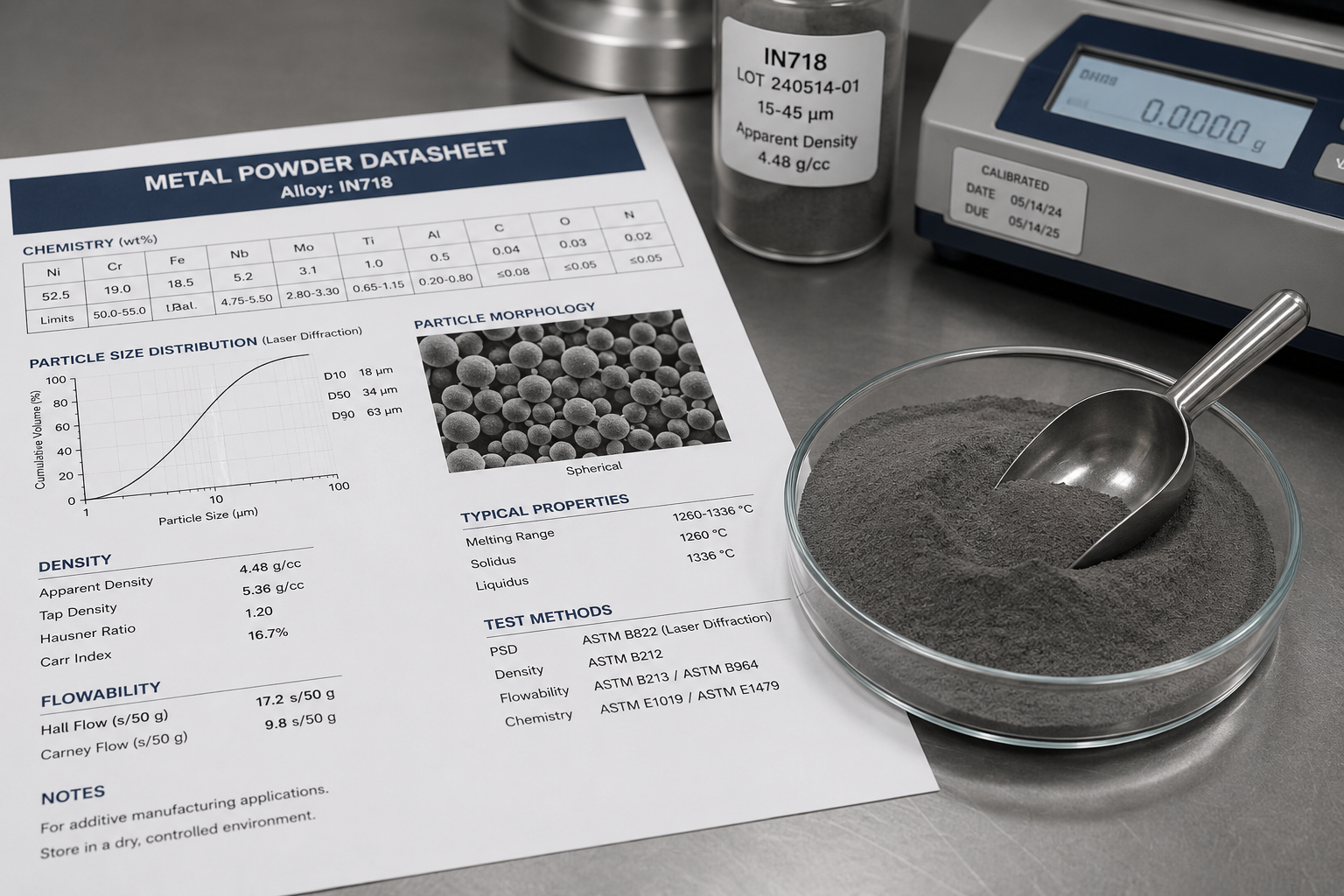
Metal powder datasheets help summarize key material properties such as chemistry, particle size distribution, density, flowability, and test methods—but those values are most useful when interpreted within the context of the intended additive manufacturing process.
Particle Size Distribution Is About More Than a Single Number
For many engineers, the eye naturally goes straight to the D50 value. That makes sense — it’s the median particle size and an easy number to compare between materials.
But PSD is really about the shape and spread of the distribution, not just the midpoint.
Two powders may share a similar D50 while behaving very differently because one contains more fines or a broader coarse tail. Those differences can affect spreading behavior, packing density, and even thermal response during processing.
This is why datasheets often include D10 and D90 values alongside D50. Together, they provide a more complete picture of how particle sizes are distributed throughout the powder.
It is also important to understand the methodology of particle size distribution testing. Datasheets will often list laser diffraction, dynamic image analysis, or sieve analysis. Each method can produce meaningful differences in results. Understanding the test methods is essential to proper characterization of powders.
Interpreting those values correctly requires context. A tighter distribution is not automatically better, and a broader distribution is not automatically worse. The right answer depends on what the process is trying to achieve.
Density Values Tell You How Powder Packs
Apparent density and tap density are another pair of values that tend to get overlooked or misunderstood.
At a basic level, they describe how powder occupies space under different conditions. Apparent density reflects how powder settles naturally under gravity, while tap density measures how densely it packs after mechanical tapping or vibration.
The relationship of those values, known as the Hausner ratio or Carr index, are common indicators of the flowability or cohesiveness of a powder. That matters because packing behavior influences much more than storage. In additive manufacturing, it can affect layer consistency, green density, and overall process stability depending on the application.
Like most powder metrics, density values become more meaningful when interpreted alongside other characteristics rather than viewed in isolation.
Flowability Numbers Need Context
Flowability data is useful, but it’s also easy to overinterpret.
Hall flow and Carney flow tests measure how powder moves through an orifice under controlled conditions. They provide a comparative baseline, particularly when evaluating lot-to-lot consistency or comparing similar materials.
What they don’t do is perfectly replicate how powder behaves inside an additive manufacturing system.
Recoating mechanisms, humidity, particle interactions, and layer thickness all influence real-world powder movement. A powder with excellent Hall flow may still present challenges in a specific process environment depending on how the rest of the material system behaves.
That’s one reason experienced engineers tend to evaluate flowability as part of a broader pattern rather than treating a single number as definitive.
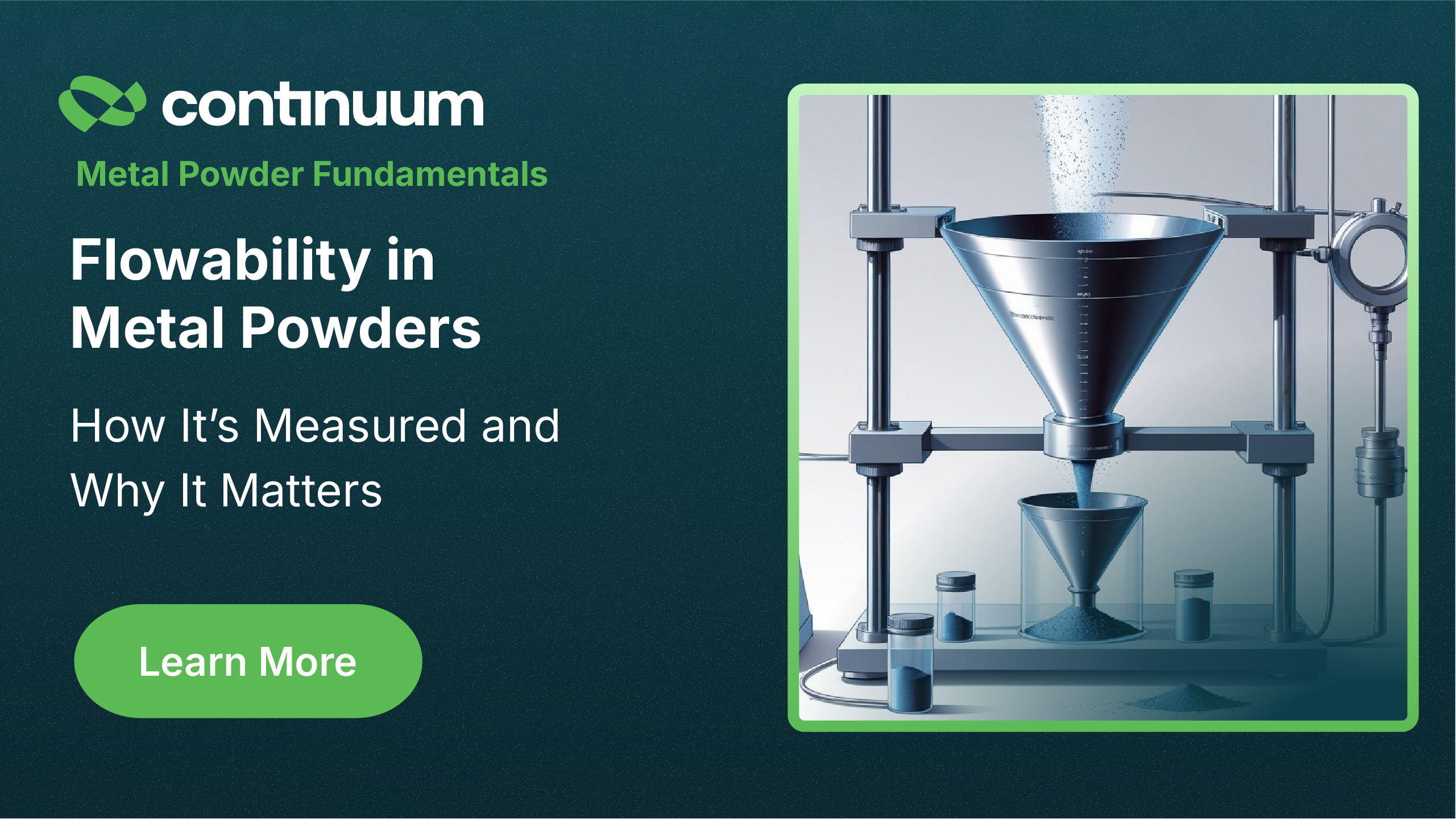
Learn how metal powder flowability is measured using Hall flow, Carney flow, angle of repose, and rotating drum testing—and why it matters for additive manufacturing performance.
Chemistry May Be the Most Important Section
While PSD and flowability often get the most attention, chemistry limits are frequently the most critical part of the datasheet — especially for high-performance applications.
Most powder datasheets list nominal alloy composition alongside maximum allowable limits for elements such as oxygen, nitrogen, sulfur, or carbon. Those limits exist for a reason. Even relatively small shifts in chemistry can influence mechanical performance, phase formation, or long-term reliability.
This becomes particularly important for reactive materials and high-temperature alloys where interstitial content must remain tightly controlled.
The chemistry section also provides insight into how seriously a supplier approaches consistency and process control. Tight, repeatable chemistry ranges are often just as important as the headline alloy designation itself.
What Datasheets Don’t Show You
One of the most important things to understand about powder datasheets is what they leave out.
A datasheet can tell you measured properties from a specific lot under defined conditions, but it doesn’t fully capture how a material behaves over time or within a specific production environment.
It doesn’t show:
- How the powder was handled
- How it responds to reuse
- How stable the material remains across multiple builds
- How process parameters interact with the powder
Those factors are often learned through testing, application experience, and process development rather than through the datasheet alone.
That’s why powder selection in additive manufacturing is rarely as simple as matching numbers line by line.
Reading the Bigger Picture
The most effective way to evaluate a powder datasheet is to stop viewing each property as an isolated metric and instead look at how the properties work together.
PSD influences flow behavior and packing. Morphology affects spreading and cohesion. Density impacts how particles settle and rearrange. Chemistry affects both processing behavior and final part performance.
Taken together, these characteristics create the real-world behavior of the powder.
At Continuum Powders, this systems-level view is a major part of how we approach powder development and customer collaboration. Different applications place different demands on materials, which is why we offer multiple PSD options across alloys and work closely with customers to align powder behavior with process requirements. The goal isn’t simply to provide a powder that meets a specification on paper, but one that performs consistently in production environments where repeatability matters most.
A Datasheet Is the Beginning of the Conversation
Datasheets are essential tools, but they’re not complete answers.
They help narrow down options, establish baselines, and provide important technical information. But the real work begins when those values are interpreted within the context of an actual manufacturing process.
The most successful additive manufacturing programs tend to approach powder evaluation the same way they approach process development: by looking at the interaction between variables rather than optimizing a single number.
That’s where datasheets become most valuable — not as isolated specifications, but as part of a much larger understanding of powder behavior.