One of additive manufacturing's most compelling promises has always been the ability to move production closer to where parts are actually needed.
Instead of maintaining warehouses full of replacement components, manufacturers can theoretically maintain digital inventories and produce parts on demand. For defense organizations, energy operators and manufacturers supporting geographically dispersed assets, that can dramatically change the economics of spare parts and sustainment.
Recent developments suggest that model is moving closer to reality. Defense organizations are experimenting with distributed manufacturing networks capable of producing parts aboard ships and at forward locations. Advanced energy programs are exploring additive manufacturing to address constrained conventional supply chains. Manufacturers are increasingly thinking about production capacity as something that can be distributed rather than centralized.
But there is an important limitation to the digital inventory concept.
The part may be digital. The material isn't.
Moving the Printer Doesn't Move the Supply Chain
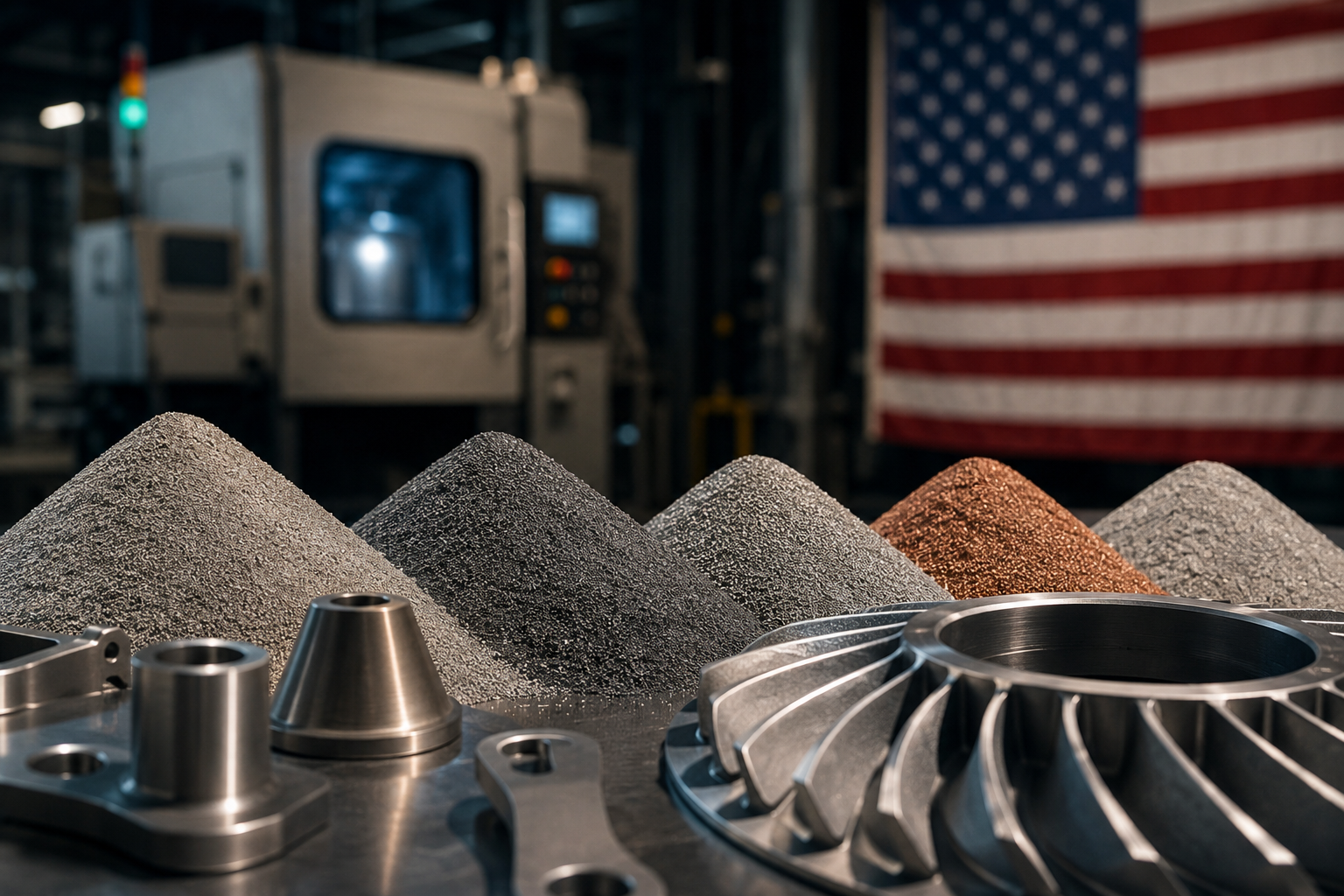
A production file can be transmitted across the world almost instantaneously. Nickel, titanium or copper feedstock still has to physically arrive at the machine.
And simply having metal powder available isn't enough.
For production applications, manufacturers need the correct alloy, chemistry, particle size distribution and material characteristics. The powder must be traceable and consistent with what was used during qualification. In regulated industries, changing the material source can introduce additional validation requirements even when the nominal alloy remains the same.
That means distributing manufacturing capacity can create a new challenge: distributed material availability. This becomes particularly important as additive moves beyond prototyping.
A machine sitting near the point of need provides limited supply-chain resilience if the qualified material required to operate it still depends on a distant, constrained or single-source supplier.
Qualification Makes Material Availability More Complicated
The issue isn't simply keeping enough powder on a shelf. Once a material and manufacturing process have been qualified together, the powder effectively becomes part of the production system.
Manufacturers therefore have to think about questions that receive considerably less attention than machine throughput:
- Can the same material be replenished reliably?
- Can additional quantities be produced without introducing significant lot-to-lot variation?
- What happens if demand increases unexpectedly?
- Is there a second source?
- Can smaller replenishment quantities be produced economically?
- What happens when the required alloy isn't commercially available as powder at all?
These questions become increasingly important for defense, aerospace, nuclear and energy applications, where production programs can remain active for decades and material requirements may outlive the commercial availability of a particular feedstock.
Specialty Materials Add Another Layer
The challenge becomes even greater when the required material isn't a standard commercial alloy.
Recent industry activity provides a useful example. Ames National Laboratory recently described researchers waiting more than a year in some cases to obtain enough high-temperature alloy powder to evaluate promising new materials.
The bottleneck wasn't discovering the alloy. It was converting that chemistry into usable powder at the scale required for development.
This is one reason flexible atomization and small-batch alloy development are becoming increasingly important parts of the material ecosystem.
At Continuum Powders, our Custom Foundry Runtime (CFR) capability is built around this problem: enabling customers to convert specialized or customer-controlled feedstock into application-ready powder without requiring the economics of a conventional large production campaign.
The same flexibility can matter later when qualified programs need smaller replenishment quantities or material requirements change.
Closing the Material Loop
Distributed manufacturing also raises another question: what happens to the material already inside the manufacturing network?
Failed parts, oversized powder fractions, obsolete components and other eligible metal streams can contain strategically valuable material.
Recent U.S. defense initiatives increasingly treat those materials as recoverable domestic resources rather than waste. That shift is particularly important for titanium, nickel and other metals with complex or geographically concentrated supply chains.
Recovering eligible material and returning it to productive use can create another source of feedstock while reducing dependence on new primary material.
That is why powder lifecycle management is likely to become increasingly relevant as distributed manufacturing scales.
The future supply chain may not simply move in one direction from powder producer to printer. It could become a loop:
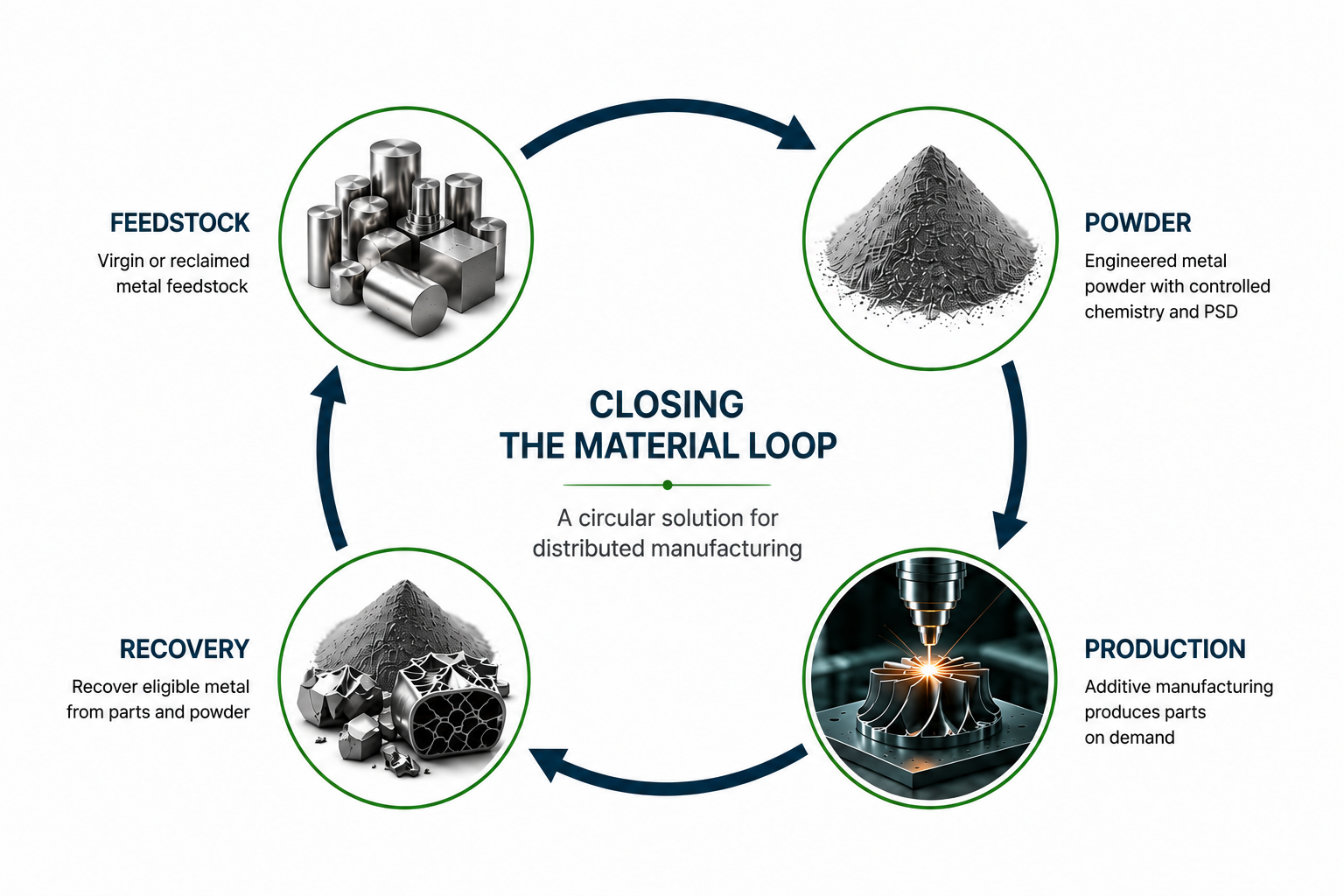
Distributed Manufacturing Still Needs a Material Strategy
Additive manufacturing can absolutely reduce dependence on centralized inventories and long conventional manufacturing lead times.
But moving the machine closer to the application doesn't eliminate the supply chain.
It changes what the supply chain needs to deliver.
Manufacturers pursuing distributed production will need to think about qualified material availability, replenishment, traceability, flexible production and eventually recovery with the same seriousness they apply to machine capacity.
Because the most sophisticated printer in the world still can't manufacture a part without the right material sitting next to it.