For several years, “domestic supply” has become one of the dominant themes in advanced manufacturing. The rationale is that aerospace, defense, and energy manufacturers have spent years confronting geopolitical uncertainty, long lead times, and concentrated sources of critical materials. Building more production capacity closer to home is an important response.
But domestic capacity alone doesn’t solve the entire problem. For manufacturers operating qualified production processes, the more consequential question is whether that material can actually be put into production when and where it is needed.
That distinction is becoming increasingly important as additive manufacturing moves from development programs into recurring production.
Capacity is only the beginning
A notable example arrived when the U.S. Army expanded its investment in IperionX’s domestic titanium manufacturing platform. The $18.5 million base task order supports an integrated system spanning titanium powder through finished defense components.
The significance is that more titanium will be produced in the United States and, perhaps more importantly, the investment extends into processing, manufacturing, and component finishing, reflecting a broader objective to create a domestic pathway capable of turning available material into usable hardware.
That same distinction applies to metal additive manufacturing. Installing another atomizer increases theoretical powder capacity, just as installing another printer increases theoretical manufacturing capacity. Neither, by itself, guarantees production.
Between those assets, one of the industry’s more persistent challenges is qualification.
Powder in the manufacturing process
In production metal AM, chemistry and particle size distribution matter, but so do morphology, flowability, contamination controls, storage, reuse practices, and lot-to-lot consistency. Powder isn’t an interchangeable raw material.
Once a manufacturer develops and validates a production process around a particular material, that powder effectively becomes part of the manufacturing system. Changing suppliers can therefore be considerably more complicated than finding another company offering the same nominal alloy.
A new source may require additional characterization, parameter validation, mechanical testing or customer approval before it can enter production. For manufacturers operating regulated or mission-critical programs, that can turn an apparent supply alternative into a months-long qualification exercise.
This is why manufacturers should increasingly distinguish between material availability and qualified material availability. The latter is what actually keeps production running.
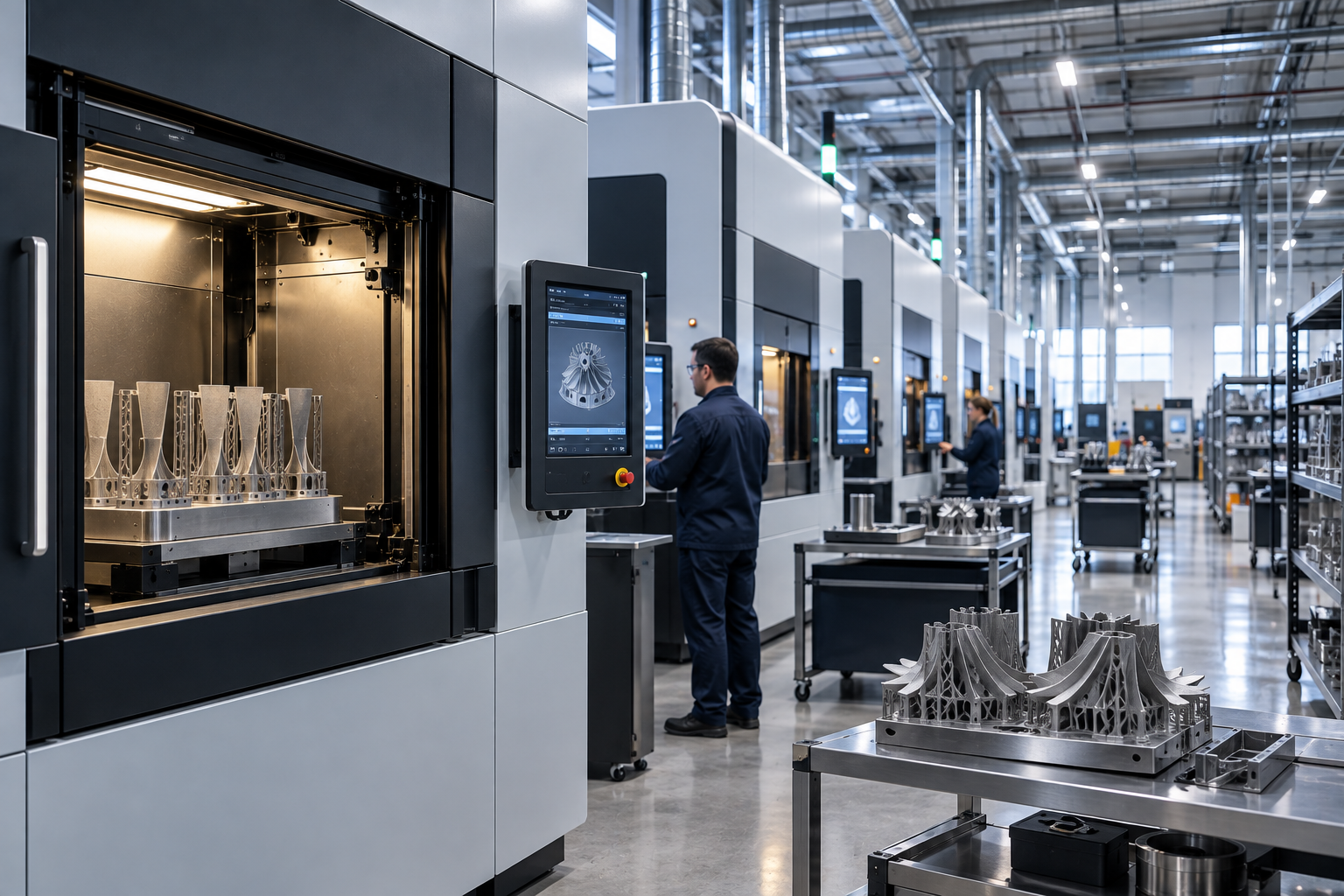
Qualification, a competitive moat
Another recent industry development offers a useful illustration. Quickparts is investing in its aerospace and defense manufacturing network while working to standardize production across facilities in the United States and Europe. Its broader strategy recognizes that equipment can be replicated relatively easily; establishing qualified manufacturing capacity across multiple locations is much harder.
That is an important distinction for the entire AM ecosystem. As manufacturing becomes more distributed, manufacturers will increasingly need to reproduce not just geometry but an entire validated production environment encompassing the machine, material, parameters, handling, inspection and documentation.
Material consistency therefore becomes part of manufacturing portability. A digital file may travel instantly, but a qualified material system has to travel with it.
Resilience before disruption
This puts a premium on flexibility as well as capacity. A supplier capable of supporting qualification quantities, different particle size distributions, and changing production requirements can help manufacturers establish a material pathway before demand reaches full-scale production.
We see this firsthand at Continuum Powders. Customers increasingly come to us looking for more than a specific alloy or particle size distribution. They are thinking about how a material will move from initial evaluation and qualification into repeat production, whether supply can adjust as requirements change, and how greater control over the material lifecycle can reduce risk over the life of a program. Supporting both reclaimed and virgin feedstocks, flexible production quantities and qualification efforts give us a useful perspective on how those priorities are changing.
For manufacturers, that kind of flexibility can be particularly valuable early in a program. The supplier selected during qualification may ultimately need to support very different volumes once the application reaches production, which makes the long-term material pathway worth considering before those decisions become difficult to change.
This article was originally published on September 21, 2026 by Voxel Matters.