Metal additive manufacturing was built to reduce waste, improve efficiency, and unlock design freedom. But the material supply chains feeding it are still heavily dependent on virgin mining, global transportation networks, and increasingly volatile sourcing conditions.
That tension is becoming more visible across aerospace, defense, energy, and industrial manufacturing, where companies are now being asked to secure domestic supply, reduce carbon exposure, and maintain high-performance material standards simultaneously.
Circular manufacturing offers a different path.
Instead of relying exclusively on newly mined ore, circular manufacturing starts with high-value alloy scrap already circulating within industry — decommissioned components, failed builds, revert material, and excess alloy stock. Through controlled melt and atomization processes, these materials can be transformed back into specification-grade additive manufacturing powder.
Download Full Brochure
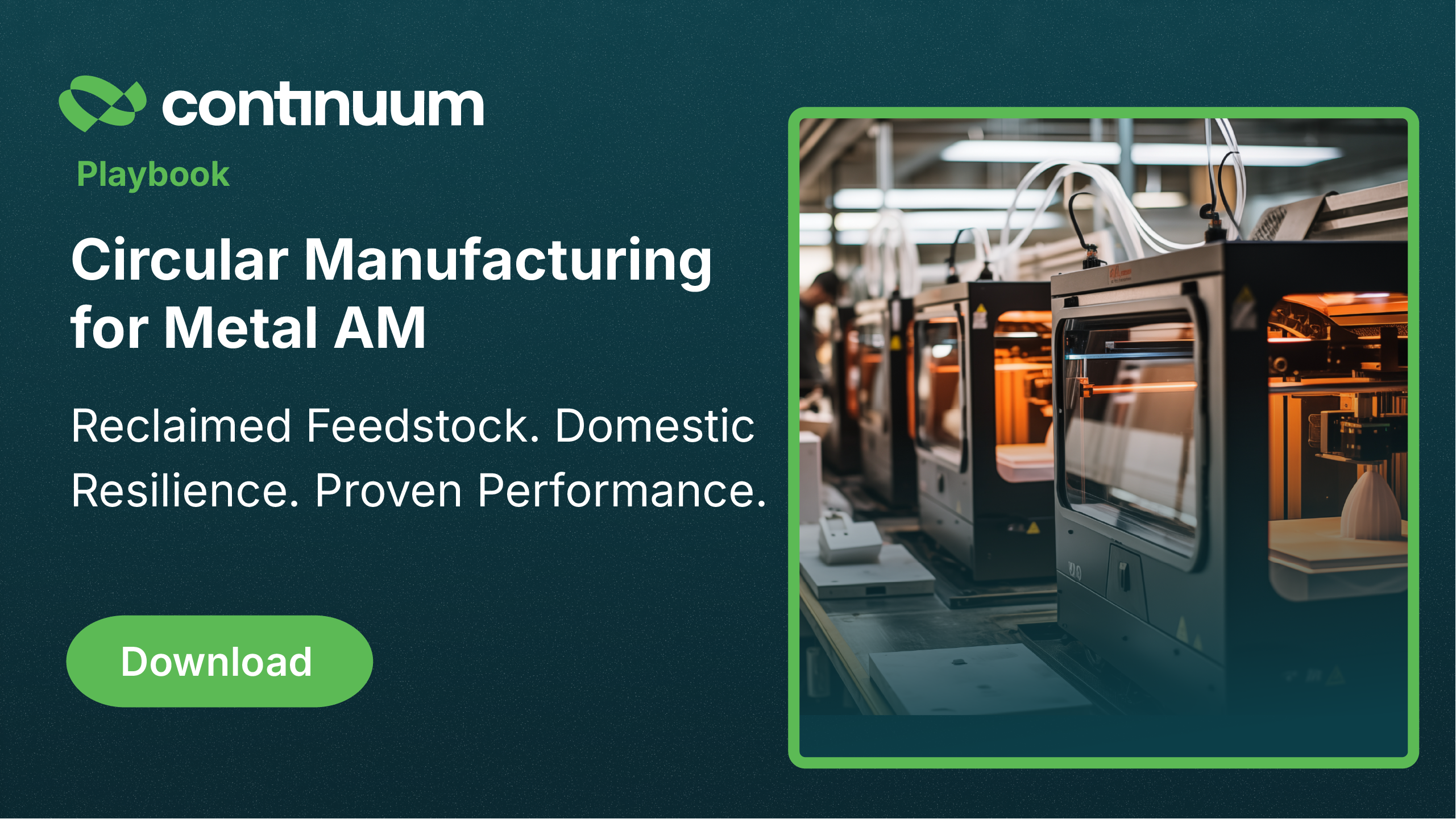
Explore how circular manufacturing is moving from concept to performance. This playbook examines reclaimed feedstock, melt-to-powder processing, and independent benchmarking that shows how reclaimed superalloy powder can support demanding AM applications.
At Continuum Powders, this process is powered through the company’s Greyhound Melt-to-Powder (M2P) platform, which combines cold-hearth plasma melting with inert gas atomization to produce reclaimed feedstock with controlled chemistry and repeatable particle morphology.
The advantages are bigger than sustainability alone.
Circular manufacturing can help manufacturers:
- Reduce dependence on imported virgin materials
- Shorten and localize supply chains
- Improve material efficiency
- Reduce exposure to commodity volatility
- Lower upstream lifecycle emissions
But performance is what ultimately determines adoption.
That’s why independent benchmarking conducted by the Rice University Particle Flow & Tribology Laboratory evaluated reclaimed M247 nickel superalloy powder against conventionally sourced stainless additive manufacturing powders.
The results showed reclaimed M247 demonstrated exceptionally strong rheological behavior during powder recoating and spreading operations, including:
- The lowest Stability Index (SI)
- The lowest Flow Rate Index (FRI)
- Very low compressibility (~2%)
- The best Additive Manufacturing Suitability (AMS) factor among powders tested
In practical terms, the reclaimed superalloy exhibited equal — and in several areas superior — powder flow performance compared to conventionally sourced stainless AM powders. That translates into more stable spreading behavior, improved process consistency, and reduced variability during additive manufacturing operations.
The broader implication is important.
Circular manufacturing is no longer just an environmental discussion. It is increasingly becoming a supply chain and manufacturing strategy discussion — one centered around resilience, repeatability, and long-term material availability.
And execution matters.
Production-scale circular manufacturing requires more than reclamation alone. It depends on controlled melt environments, analytical chemistry, particle size management, traceability, and disciplined quality systems working together as a unified process.
The full Circular Manufacturing Playbook for Metal Additive Manufacturing explores these concepts in greater depth, including:
- Independent Rice University benchmarking data
- Powder flow fundamentals
- Recoating and rheology analysis
- Supply chain implications
- Operational advantages for powder bed fusion and binder jetting
Download the full playbook to learn how reclaimed feedstock is evolving into a performance-validated supply strategy for advanced manufacturing.